Ch. 2 - Limits and Continuity
Hass - Thomas' Calculus 15th Edition
Hass15th EditionThomas' CalculusISBN: 9780137616077Non è quello che usi tu?Cambia libro di testo
Capitolo 2, Problema 2.4.14

Finding One-Sided Limits Algebraically


Find the limits in Exercises 11–20.


limx→1− (1/(x + 1))((x + 6)/x)((3 − x)/7)

Guida verificata passo dopo passo
1
Identify the expression for which you need to find the one-sided limit as x approaches 1 from the left: \( \lim_{x \to 1^-} \frac{1}{x + 1} \cdot \frac{x + 6}{x} \cdot \frac{3 - x}{7} \).
Break down the expression into three separate fractions: \( \frac{1}{x + 1} \), \( \frac{x + 6}{x} \), and \( \frac{3 - x}{7} \).
Evaluate the limit of each fraction separately as x approaches 1 from the left. Start with \( \lim_{x \to 1^-} \frac{1}{x + 1} \). Since x is approaching 1 from the left, x + 1 approaches 2, so the limit is \( \frac{1}{2} \).
Next, evaluate \( \lim_{x \to 1^-} \frac{x + 6}{x} \). As x approaches 1 from the left, x + 6 approaches 7 and x approaches 1, so the limit is \( \frac{7}{1} = 7 \).
Finally, evaluate \( \lim_{x \to 1^-} \frac{3 - x}{7} \). As x approaches 1 from the left, 3 - x approaches 2, so the limit is \( \frac{2}{7} \). Multiply the results of the individual limits: \( \frac{1}{2} \cdot 7 \cdot \frac{2}{7} \).

Risposta video verificata per un problema simile:

Questa soluzione video è stata consigliata dai nostri tutor come utile per risolvere questo problema.
Durata del video:
2m

Concetti chiave

Ecco i concetti essenziali che devi comprendere per rispondere correttamente alla domanda.

One-Sided Limits

One-sided limits refer to the value that a function approaches as the input approaches a specific point from one side, either the left (denoted as x→c−) or the right (denoted as x→c+). In this case, we are interested in the left-hand limit as x approaches 1, which involves evaluating the function as x gets closer to 1 from values less than 1.
Video consigliato:
05:50
One-Sided Limits

Algebraic Manipulation

Algebraic manipulation involves simplifying expressions to make limit calculations easier. This can include factoring, canceling common terms, or substituting values. In the given limit expression, simplifying the product of the fractions will help in evaluating the limit as x approaches 1 from the left.
Video consigliato:
05:25
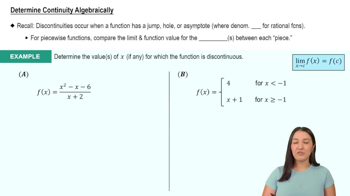
Determine Continuity Algebraically

Continuity and Discontinuity

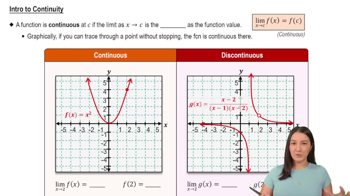
Continuity at a point means that the limit of a function as it approaches that point equals the function's value at that point. Discontinuity occurs when this is not the case. Understanding whether the function is continuous at x = 1 will help determine if the limit can be directly evaluated or if further analysis is needed.
Video consigliato:
05:34
Intro to Continuity