Ch. 2 - Limits and Continuity
Hass - Thomas' Calculus 15th Edition
Hass15th EditionThomas' CalculusISBN: 9780137616077Non è quello che usi tu?Cambia libro di testo
Capitolo 2, Problema 50

Find the limits in Exercises 49–52. Write ∞ or −∞ where appropriate.


lim x→(−π/2)⁺ sec x

Guida verificata passo dopo passo
1
Understand the function: The secant function, sec(x), is defined as 1/cos(x). As x approaches a certain value, we need to consider the behavior of the cosine function.
Identify the point of interest: We are looking at the limit as x approaches -π/2 from the right (denoted as x→(-π/2)⁺). This means we are considering values of x that are slightly greater than -π/2.
Analyze the cosine function: At x = -π/2, cos(x) is 0. As x approaches -π/2 from the right, cos(x) approaches 0 from the positive side, meaning cos(x) is positive but very small.
Consider the behavior of sec(x): Since sec(x) = 1/cos(x), as cos(x) approaches 0 from the positive side, sec(x) will become very large. This indicates that sec(x) approaches positive infinity.
Conclude the limit: Based on the analysis, the limit of sec(x) as x approaches -π/2 from the right is ∞.

Risposta video verificata per un problema simile:

Questa soluzione video è stata consigliata dai nostri tutor come utile per risolvere questo problema.
Durata del video:
2m

Concetti chiave

Ecco i concetti essenziali che devi comprendere per rispondere correttamente alla domanda.

Limits

Limits are fundamental concepts in calculus that describe the behavior of a function as its input approaches a certain value. They help in understanding how functions behave near points of interest, including points of discontinuity or infinity. Evaluating limits is essential for defining derivatives and integrals, which are core components of calculus.
Video consigliato:
05:50
One-Sided Limits

Secant Function

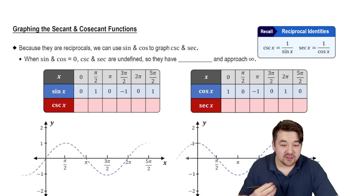
The secant function, denoted as sec(x), is defined as the reciprocal of the cosine function: sec(x) = 1/cos(x). It is important to understand the behavior of sec(x) as x approaches certain values, particularly where cos(x) equals zero, since this leads to undefined values and vertical asymptotes in the secant function.
Video consigliato:
Percorso guidato
6:22
Graphs of Secant and Cosecant Functions

One-Sided Limits

One-sided limits refer to the value that a function approaches as the input approaches a specific point from one side, either the left (−) or the right (+). In the context of the given limit, evaluating the right-hand limit as x approaches −π/2 helps determine the behavior of sec(x) near this critical point, which is essential for understanding discontinuities in the function.
Video consigliato:
05:50
One-Sided Limits
Pratica correlata
Domanda del libro di testo

Find the limits in Exercises 49–52. Write ∞ or −∞ where appropriate.


lim θ→0 (2 − cot θ)

238
views

Domanda del libro di testo

Continuous Extension


Explain why the function ƒ(𝓍) = sin(1/𝓍) has no continuous extension to 𝓍 = 0.

418
views
Domanda del libro di testo

Find the limits in Exercises 53–58. Write ∞ or −∞ where appropriate.


lim x/(x² − 1) as


d. x→−1⁻

240
views
Domanda del libro di testo

[Technology Exercise] Grinding engine cylinders Before contracting to grind engine cylinders to a cross-sectional area of 9in², you need to know how much deviation from the ideal cylinder diameter of c = 3.385in. you can allow and still have the area come within 0.01in² of the required 9in². To find out, you let A=π(x/2)² and look for the largest interval in which you must hold x to make |A − 9| ≤ 0.01. What interval do you find?

306
views
Domanda del libro di testo

[Technology Exercise] Roots


Let ƒ(𝓍) = 𝓍³ ―𝓍― 1.


c. It can be shown that the exact value of the solution in part (b) is


(1/2 + √69/18)¹/³ + (1/2 ― √69/18)¹/³


Evaluate this exact answer and compare it with the value you found in part (b).

168
views
Domanda del libro di testo

[Technology Exercise] In Exercises 33–36, graph the function to see whether it appears to have a continuous extension to the given point a. If it does, use Trace and Zoom to find a good candidate for the extended function’s value at a. If the function does not appear to have a continuous extension, can it be extended to be continuous from the right or left? If so, what do you think the extended function’s value should be?


g(θ) = 5 cos θ / (4θ ― 2π) , a = π/2

248
views