Ch. 2 - Limits and Continuity
Hass - Thomas' Calculus 15th Edition
Hass15th EditionThomas' CalculusISBN: 9780137616077Non è quello che usi tu?Cambia libro di testo
Capitolo 2, Problema 34

[Technology Exercise] In Exercises 33–36, graph the function to see whether it appears to have a continuous extension to the given point a. If it does, use Trace and Zoom to find a good candidate for the extended function’s value at a. If the function does not appear to have a continuous extension, can it be extended to be continuous from the right or left? If so, what do you think the extended function’s value should be?


g(θ) = 5 cos θ / (4θ ― 2π) , a = π/2

Guida verificata passo dopo passo
1
Identify the function given: \( g(\theta) = \frac{5 \cos \theta}{4\theta - 2\pi} \) and the point \( a = \frac{\pi}{2} \).
Check for continuity at \( a = \frac{\pi}{2} \) by substituting \( \theta = \frac{\pi}{2} \) into the denominator \( 4\theta - 2\pi \). If the denominator equals zero, the function is not defined at this point.
Since the denominator becomes zero at \( \theta = \frac{\pi}{2} \), the function is not defined at this point, indicating a potential discontinuity.
Use a graphing tool to plot \( g(\theta) \) and observe the behavior of the function as \( \theta \) approaches \( \frac{\pi}{2} \) from both the left and the right.
Determine if the function can be extended to be continuous from either the left or the right by observing the limit of \( g(\theta) \) as \( \theta \) approaches \( \frac{\pi}{2} \). If the left-hand limit and right-hand limit are equal, suggest this common value as the extended function's value at \( a = \frac{\pi}{2} \).

Risposta video verificata per un problema simile:

Questa soluzione video è stata consigliata dai nostri tutor come utile per risolvere questo problema.
Durata del video:
9m

Concetti chiave

Ecco i concetti essenziali che devi comprendere per rispondere correttamente alla domanda.

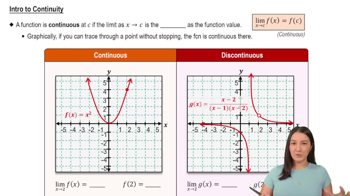
Continuous Functions

A function is continuous at a point if the limit of the function as it approaches that point equals the function's value at that point. This means there are no breaks, jumps, or holes in the graph of the function at that point. Understanding continuity is crucial for determining whether a function can be extended to include a specific point.
Video consigliato:
05:34
Intro to Continuity

Limits

The limit of a function describes the behavior of the function as it approaches a particular input value. It is essential for analyzing functions at points where they may not be defined or where they exhibit discontinuities. In this exercise, evaluating the limit of g(θ) as θ approaches π/2 will help determine if a continuous extension exists.
Video consigliato:
05:50
One-Sided Limits

Right-Hand and Left-Hand Limits

Right-hand and left-hand limits refer to the values that a function approaches as the input approaches a specific point from the right (greater values) or the left (smaller values). These concepts are important for assessing whether a function can be extended continuously from one side, which is particularly relevant when the overall limit does not exist but one-sided limits do.
Video consigliato:
Percorso guidato
07:39
Left, Right, & Midpoint Riemann Sums