Ch. 2 - Limits and Continuity
Hass - Thomas' Calculus 15th Edition
Hass15th EditionThomas' CalculusISBN: 9780137616077Non è quello che usi tu?Cambia libro di testo
Capitolo 2, Problema 57a

Find the limits in Exercises 53–58. Write ∞ or −∞ where appropriate.


lim (x² − 3x + 2) / (x³ − 2x²) as


a. x→0⁺

Guida verificata passo dopo passo
1
Step 1: Begin by substituting x = 0 into the function \((x^2 - 3x + 2) / (x^3 - 2x^2)\) to check if the limit can be directly evaluated. This will help identify if the function is undefined at x = 0.
Step 2: Since direct substitution results in an indeterminate form \(0/0\), apply L'Hôpital's Rule, which is used to evaluate limits of indeterminate forms. Differentiate the numerator \(x^2 - 3x + 2\) and the denominator \(x^3 - 2x^2\) separately.
Step 3: Differentiate the numerator: \(\frac{d}{dx}(x^2 - 3x + 2) = 2x - 3\). Differentiate the denominator: \(\frac{d}{dx}(x^3 - 2x^2) = 3x^2 - 4x\).
Step 4: Substitute x = 0 into the differentiated function \((2x - 3) / (3x^2 - 4x)\) to evaluate the limit as x approaches 0 from the positive side.
Step 5: Analyze the behavior of the function as x approaches 0 from the positive side. Consider the signs of the numerator and denominator to determine if the limit approaches \(\infty\), \(-\infty\), or a finite value.

Risposta video verificata per un problema simile:

Questa soluzione video è stata consigliata dai nostri tutor come utile per risolvere questo problema.
Durata del video:
2m

Concetti chiave

Ecco i concetti essenziali che devi comprendere per rispondere correttamente alla domanda.

Limits

Limits are fundamental concepts in calculus that describe the behavior of a function as its input approaches a certain value. They help in understanding the function's behavior near points of interest, including points where the function may not be explicitly defined. Evaluating limits is crucial for determining continuity, derivatives, and integrals.
Video consigliato:
05:50
One-Sided Limits

Rational Functions

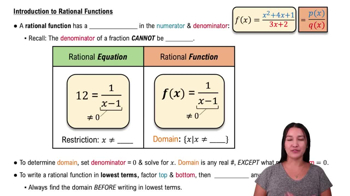
Rational functions are expressions formed by the ratio of two polynomials. In the given limit problem, the function consists of a polynomial in the numerator and another in the denominator. Understanding how to simplify and analyze rational functions is essential for finding limits, especially when dealing with indeterminate forms.
Video consigliato:
6:04
Intro to Rational Functions

One-Sided Limits

One-sided limits refer to the value that a function approaches as the input approaches a specific point from one side, either the left (x→c⁻) or the right (x→c⁺). In this problem, evaluating the limit as x approaches 0 from the positive side (0⁺) is important for understanding the function's behavior near that point, particularly when the function may behave differently from each side.
Video consigliato:
05:50
One-Sided Limits