Ch. 2 - Limits and Continuity
Hass - Thomas' Calculus 15th Edition
Hass15th EditionThomas' CalculusISBN: 9780137616077Non è quello che usi tu?Cambia libro di testo
Capitolo 2, Problema 2.6.86

Finding Limits of Differences When x → ±∞


Find the limits in Exercises 84–90. (Hint: Try multiplying and dividing by the conjugate.)


lim x → −∞ (√(x² + 3) + x)

Guida verificata passo dopo passo
1
Identify the expression for which you need to find the limit: \( \lim_{x \to -\infty} (\sqrt{x^2 + 3} + x) \).
To simplify the expression, multiply and divide by the conjugate: \( \frac{(\sqrt{x^2 + 3} + x)(\sqrt{x^2 + 3} - x)}{\sqrt{x^2 + 3} - x} \).
The numerator becomes a difference of squares: \((\sqrt{x^2 + 3})^2 - x^2 = x^2 + 3 - x^2 = 3\).
Now, the expression simplifies to: \( \frac{3}{\sqrt{x^2 + 3} - x} \).
Analyze the behavior of the denominator as \( x \to -\infty \). Simplify \( \sqrt{x^2 + 3} \approx |x| \) for large \( |x| \), and consider the limit of the simplified expression.

Risposta video verificata per un problema simile:

Questa soluzione video è stata consigliata dai nostri tutor come utile per risolvere questo problema.
Durata del video:
5m

Concetti chiave

Ecco i concetti essenziali che devi comprendere per rispondere correttamente alla domanda.

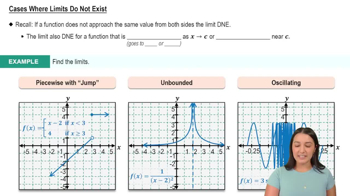
Limits at Infinity

Limits at infinity involve evaluating the behavior of a function as the variable approaches positive or negative infinity. This concept is crucial for understanding how functions behave in extreme cases, often revealing horizontal asymptotes or end behavior. In the context of the given limit, we analyze how the expression behaves as x becomes very large or very small.
Video consigliato:
03:07
Cases Where Limits Do Not Exist

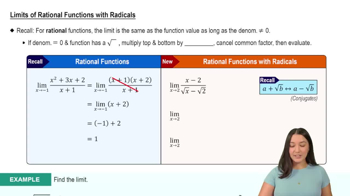
Conjugates in Limits

Using conjugates is a technique in calculus that simplifies expressions involving square roots. By multiplying and dividing by the conjugate, we can eliminate square roots in the numerator or denominator, making it easier to evaluate limits. This method is particularly useful when dealing with indeterminate forms that arise in limit calculations.
Video consigliato:
06:13
Limits of Rational Functions with Radicals

Square Root Functions

Square root functions, such as √(x² + 3), are essential in calculus for understanding how they behave as x approaches infinity or negative infinity. The square root of a squared term dominates the behavior of the function, allowing us to simplify the limit. Recognizing how these functions interact with linear terms is key to solving the limit problem presented.
Video consigliato:
Percorso guidato
7:24
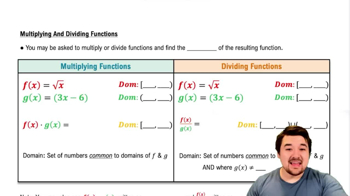
Multiplying & Dividing Functions