Ch. 2 - Limits and Continuity
Hass - Thomas' Calculus 15th Edition
Hass15th EditionThomas' CalculusISBN: 9780137616077Non è quello che usi tu?Cambia libro di testo
Capitolo 2, Problema 2.6.3

Finding Limits


In Exercises 3–8, find the limit of each function (a) as x → ∞ and (b) as x → −∞. (You may wish to visualize your answer with a graphing calculator or computer.)


f(x) = 2/x − 3

Guida verificata passo dopo passo
1
Step 1: Understand the function f(x) = 2/x - 3. This is a rational function where the term 2/x will approach zero as x approaches infinity or negative infinity.
Step 2: Consider the limit as x approaches infinity (x → ∞). As x becomes very large, the term 2/x becomes very small, approaching zero. Therefore, the function f(x) approaches -3.
Step 3: Consider the limit as x approaches negative infinity (x → -∞). Similarly, as x becomes very large in the negative direction, the term 2/x also approaches zero. Therefore, the function f(x) approaches -3.
Step 4: Visualize the behavior of the function using a graphing calculator or computer. The graph will show that as x moves towards positive or negative infinity, the function approaches the horizontal line y = -3.
Step 5: Conclude that the limits are: (a) as x → ∞, the limit of f(x) is -3; (b) as x → -∞, the limit of f(x) is also -3.

Risposta video verificata per un problema simile:

Questa soluzione video è stata consigliata dai nostri tutor come utile per risolvere questo problema.
Durata del video:
2m

Concetti chiave

Ecco i concetti essenziali che devi comprendere per rispondere correttamente alla domanda.

Limits

Limits are fundamental in calculus, representing the value that a function approaches as the input approaches a certain point. They are crucial for understanding the behavior of functions at specific points, including infinity. In this context, finding the limit as x approaches infinity or negative infinity helps determine the end behavior of the function.
Video consigliato:
05:50
One-Sided Limits

Asymptotic Behavior

Asymptotic behavior describes how a function behaves as its input grows very large or very small. For rational functions, this often involves identifying horizontal or vertical asymptotes, which indicate the values the function approaches but may never reach. Understanding this concept is essential for analyzing limits at infinity.
Video consigliato:
03:07
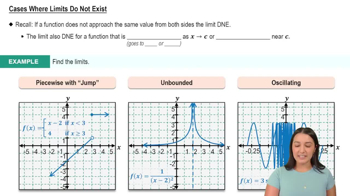
Cases Where Limits Do Not Exist

Graphical Interpretation

Graphical interpretation involves using graphs to visualize the behavior of functions, particularly as they approach limits. By plotting the function, one can observe trends and asymptotic behavior, making it easier to understand how the function behaves at extreme values of x. This visual approach can complement analytical methods in finding limits.
Video consigliato:
05:02
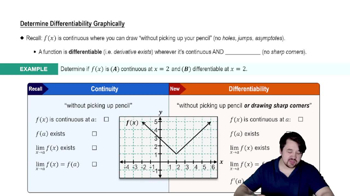
Determining Differentiability Graphically