Ch. 2 - Limits and Continuity
Hass - Thomas' Calculus 15th Edition
Hass15th EditionThomas' CalculusISBN: 9780137616077Non è quello che usi tu?Cambia libro di testo
Capitolo 2, Problema 2.4.16

Finding One-Sided Limits Algebraically


Find the limits in Exercises 11–20.


limh→0− (√6 − √(5h² + 11h + 6))/ h

Guida verificata passo dopo passo
1
Identify the expression for the one-sided limit: limh→0− (√6 − √(5h² + 11h + 6))/h. This is a left-hand limit as h approaches 0 from the negative side.
Recognize that direct substitution of h = 0 results in an indeterminate form 0/0. To resolve this, we can use algebraic manipulation, such as multiplying by the conjugate.
Multiply the numerator and the denominator by the conjugate of the numerator: (√6 + √(5h² + 11h + 6)). This will help eliminate the square roots in the numerator.
Simplify the expression: The numerator becomes (6 - (5h² + 11h + 6)) = -5h² - 11h. The denominator becomes h(√6 + √(5h² + 11h + 6)).
Factor out h from the numerator: -h(5h + 11). Cancel the h in the numerator and denominator, then evaluate the limit as h approaches 0 from the left.

Risposta video verificata per un problema simile:

Questa soluzione video è stata consigliata dai nostri tutor come utile per risolvere questo problema.
Durata del video:
5m

Concetti chiave

Ecco i concetti essenziali che devi comprendere per rispondere correttamente alla domanda.

One-Sided Limits

One-sided limits refer to the value that a function approaches as the input approaches a specific point from one side, either the left (denoted as h→0−) or the right (h→0+). Understanding one-sided limits is crucial for analyzing functions that may behave differently from each side of a point, especially at points of discontinuity or where the function is not defined.
Video consigliato:
05:50
One-Sided Limits

Algebraic Manipulation

Algebraic manipulation involves rearranging and simplifying expressions to make limits easier to evaluate. In the context of limits, this often includes factoring, rationalizing, or combining terms to eliminate indeterminate forms like 0/0, which can arise when directly substituting the limit value into the function.
Video consigliato:
05:25
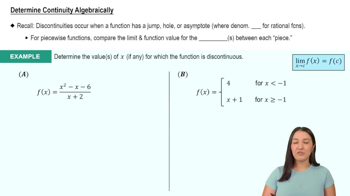
Determine Continuity Algebraically

Rationalization

Rationalization is a technique used to eliminate square roots or other irrational expressions from the denominator or numerator of a fraction. In the given limit problem, rationalizing the numerator can help simplify the expression, making it easier to evaluate the limit as h approaches 0 from the left.
Video consigliato:
6:04
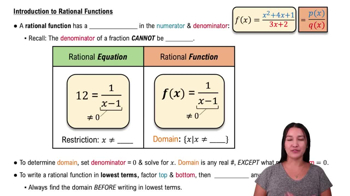
Intro to Rational Functions