Ch. 2 - Limits and Continuity
Hass - Thomas' Calculus 15th Edition
Hass15th EditionThomas' CalculusISBN: 9780137616077Non è quello che usi tu?Cambia libro di testo
Capitolo 2, Problema 2.6.63

Graphing Simple Rational Functions


Graph the rational functions in Exercises 63–68. Include the graphs and equations of the asymptotes and dominant terms.


y = 1/(x − 1)

Guida verificata passo dopo passo
1
Identify the vertical asymptote by setting the denominator equal to zero: solve x - 1 = 0, which gives x = 1. This is where the function is undefined.
Determine the horizontal asymptote by analyzing the degrees of the numerator and the denominator. Since the degree of the numerator (0) is less than the degree of the denominator (1), the horizontal asymptote is y = 0.
Find the x-intercept by setting the numerator equal to zero: solve 1 = 0, which indicates there is no x-intercept since the numerator is a constant non-zero value.
Find the y-intercept by evaluating the function at x = 0: y = 1/(0 - 1) = -1. So, the y-intercept is at (0, -1).
Sketch the graph using the asymptotes and intercepts. The graph approaches the vertical asymptote x = 1 and the horizontal asymptote y = 0, and passes through the point (0, -1).

Risposta video verificata per un problema simile:

Questa soluzione video è stata consigliata dai nostri tutor come utile per risolvere questo problema.
Durata del video:
5m

Concetti chiave

Ecco i concetti essenziali che devi comprendere per rispondere correttamente alla domanda.

Rational Functions

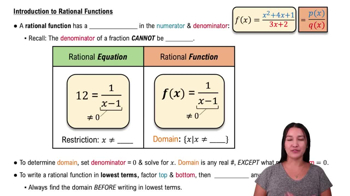
A rational function is a ratio of two polynomials, typically expressed as f(x) = P(x)/Q(x), where P(x) and Q(x) are polynomials. Understanding rational functions involves analyzing their behavior, including identifying asymptotes, intercepts, and the overall shape of the graph. The function y = 1/(x − 1) is a simple rational function with a linear denominator.
Video consigliato:
6:04
Intro to Rational Functions

Asymptotes

Asymptotes are lines that a graph approaches but never touches. For rational functions, vertical asymptotes occur where the denominator is zero, and horizontal asymptotes are determined by the degrees of the polynomials. In y = 1/(x − 1), the vertical asymptote is x = 1, as the function is undefined at this point, and the horizontal asymptote is y = 0, indicating the behavior as x approaches infinity.
Video consigliato:
Percorso guidato
5:37
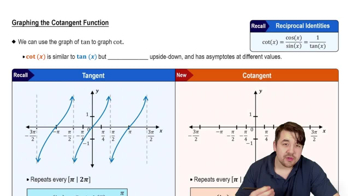
Introduction to Cotangent Graph

Dominant Terms

Dominant terms in a rational function are those that dictate the behavior of the function as x approaches infinity or negative infinity. For y = 1/(x − 1), the dominant term is 1/x, which influences the horizontal asymptote and the end behavior of the graph. Understanding dominant terms helps in sketching the graph and predicting its long-term behavior.
Video consigliato:
2:02
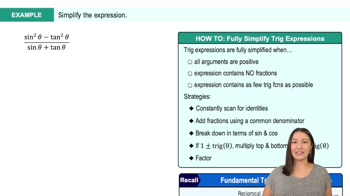
Simplifying Trig Expressions Example 1
Pratica correlata
Domanda del libro di testo

Finding Limits


In Exercises 3–8, find the limit of each function (a) as x → ∞ and (b) as x → −∞. (You may wish to visualize your answer with a graphing calculator or computer.)


h(x) = (−5 + (7/x))/(3 – (1/x²))

262
views

Domanda del libro di testo

Finding Limits of Differences When x → ±∞


Find the limits in Exercises 84–90. (Hint: Try multiplying and dividing by the conjugate.)


lim x → ∞ (√(x² + x) − √(x² − x))

321
views
Domanda del libro di testo

Exercises 5–10 refer to the function

f(x) = { x² − 1, −1 ≤ x < 0

2x, 0 < x < 1

1, x = 1

−2x + 4, 1 < x < 2

0, 2 < x < 3

graphed in the accompanying figure.

<IMAGE>

At what values of x is f continuous?

222
views
Domanda del libro di testo

Use formal definitions to prove the limit statements in Exercises 93–96.


lim x → 0 (1 / |x|) = ∞

380
views
Domanda del libro di testo

Using the Formal Definitions


Use the formal definitions of limits as x → ±∞ to establish the limits in Exercises 91 and 92.


If f has the constant value f(x) = k, then lim x → ∞ f(x) = k.

315
views
Domanda del libro di testo

Limits as x → ∞ or x → −∞


The process by which we determine limits of rational functions applies equally well to ratios containing noninteger or negative powers of x. Divide numerator and denominator by the highest power of x in the denominator and proceed from there. Find the limits in Exercises 23–36. Write ∞ or −∞ where appropriate.


lim x → ⁻∞ ((1 − x³) / (x² + 7x))⁵

315
views