Ch. 2 - Limits and Continuity
Hass - Thomas' Calculus 15th Edition
Hass15th EditionThomas' CalculusISBN: 9780137616077Non è quello che usi tu?Cambia libro di testo
Capitolo 2, Problema 2.6.66

Graphing Simple Rational Functions


Graph the rational functions in Exercises 63–68. Include the graphs and equations of the asymptotes and dominant terms.


y = −3/(x − 3)

Guida verificata passo dopo passo
1
Identify the type of rational function: The given function is y = -3/(x - 3), which is a simple rational function with a single term in the denominator.
Determine the vertical asymptote: Set the denominator equal to zero, x - 3 = 0, which gives x = 3. This is the vertical asymptote of the function.
Determine the horizontal asymptote: Since the degree of the numerator is less than the degree of the denominator, the horizontal asymptote is y = 0.
Analyze the behavior near the asymptotes: As x approaches 3 from the left, the function y = -3/(x - 3) tends to negative infinity, and as x approaches 3 from the right, the function tends to positive infinity.
Sketch the graph: Plot the vertical asymptote at x = 3 and the horizontal asymptote at y = 0. Draw the curve approaching these asymptotes, showing the behavior described in the previous step.

Risposta video verificata per un problema simile:

Questa soluzione video è stata consigliata dai nostri tutor come utile per risolvere questo problema.
Durata del video:
6m

Concetti chiave

Ecco i concetti essenziali che devi comprendere per rispondere correttamente alla domanda.

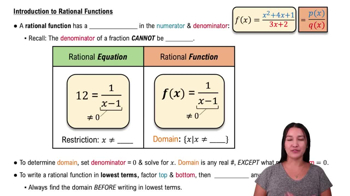
Rational Functions

A rational function is a ratio of two polynomials, typically expressed as f(x) = P(x)/Q(x), where P(x) and Q(x) are polynomials. Understanding the behavior of rational functions involves analyzing their domain, asymptotes, and intercepts. The function y = -3/(x - 3) is a simple rational function with a linear polynomial in the denominator.
Video consigliato:
6:04
Intro to Rational Functions

Asymptotes

Asymptotes are lines that a graph approaches but never touches. For rational functions, vertical asymptotes occur where the denominator is zero, and horizontal or oblique asymptotes describe end behavior. In y = -3/(x - 3), the vertical asymptote is x = 3, indicating where the function is undefined and the graph approaches infinity.
Video consigliato:
Percorso guidato
5:37
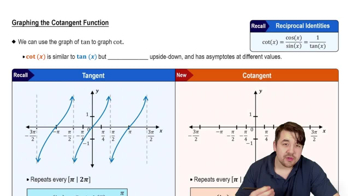
Introduction to Cotangent Graph

Dominant Terms

Dominant terms in a rational function determine its behavior as x approaches infinity or negative infinity. For y = -3/(x - 3), the dominant term is -3/x, which influences the horizontal asymptote. As x becomes very large or very small, the function approaches y = 0, indicating a horizontal asymptote at y = 0.
Video consigliato:
2:02
Simplifying Trig Expressions Example 1