Ch. 2 - Limits and Continuity
Hass - Thomas' Calculus 15th Edition
Hass15th EditionThomas' CalculusISBN: 9780137616077Non è quello che usi tu?Cambia libro di testo
Capitolo 2, Problema 114b

[Technology Exercise] Graph the functions in Exercises 113 and 114. Then answer the following questions.


b. How does the graph behave as x → ±∞?


Give reasons for your answers.


y = (3/2)(x / (x − 1))²/³

Guida verificata passo dopo passo
1
Step 1: Begin by understanding the function y = \( \frac{3}{2} \left( \frac{x}{x - 1} \right)^{\frac{2}{3}} \). This is a rational function raised to a fractional power, which affects its graph and behavior.
Step 2: Identify the domain of the function. The expression \( \frac{x}{x - 1} \) is undefined when x = 1, so the domain excludes x = 1. Consider the behavior of the function as x approaches 1 from both sides.
Step 3: Analyze the behavior of the function as x approaches ±∞. As x → ∞, the term \( \frac{x}{x - 1} \) approaches 1, and thus \( \left( \frac{x}{x - 1} \right)^{\frac{2}{3}} \) approaches 1. Similarly, as x → -∞, the term \( \frac{x}{x - 1} \) approaches 1, and the function behaves similarly.
Step 4: Consider the vertical asymptote at x = 1. As x approaches 1 from the left, \( \frac{x}{x - 1} \) becomes very large negatively, and as x approaches 1 from the right, \( \frac{x}{x - 1} \) becomes very large positively. This affects the graph's behavior near x = 1.
Step 5: Graph the function using technology to visualize its behavior. Observe the horizontal asymptote as x → ±∞ and the vertical asymptote at x = 1. The graph should show how the function approaches these asymptotes.

Risposta video verificata per un problema simile:

Questa soluzione video è stata consigliata dai nostri tutor come utile per risolvere questo problema.
Durata del video:
3m

Concetti chiave

Ecco i concetti essenziali che devi comprendere per rispondere correttamente alla domanda.

End Behavior of Functions

The end behavior of a function describes how the function behaves as the input values (x) approach positive or negative infinity. For rational functions, this often involves analyzing the degrees of the numerator and denominator to determine horizontal or oblique asymptotes, which indicate the function's behavior at extreme values of x.
Video consigliato:
5:46
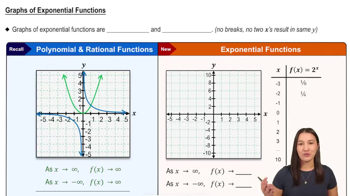
Graphs of Exponential Functions

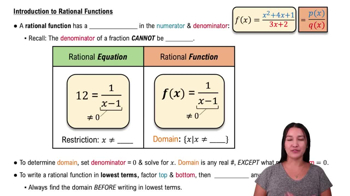
Rational Functions

A rational function is a ratio of two polynomials. The behavior of these functions is influenced by the degrees of the polynomials in the numerator and denominator. Key features include vertical asymptotes, which occur where the denominator is zero, and horizontal or oblique asymptotes, which describe the function's end behavior.
Video consigliato:
6:04
Intro to Rational Functions

Asymptotic Analysis

Asymptotic analysis involves studying the behavior of functions as they approach certain limits, such as infinity. For the given function, identifying vertical and horizontal asymptotes helps understand how the function behaves near these limits, providing insight into its long-term behavior as x approaches positive or negative infinity.
Video consigliato:
Percorso guidato
06:29
Derivatives Applied To Velocity