Ch. 3 - Derivatives
Hass - Thomas' Calculus 15th Edition
Hass15th EditionThomas' CalculusISBN: 9780137616077Non è quello che usi tu?Cambia libro di testo
Capitolo 3, Problema 3.8.33

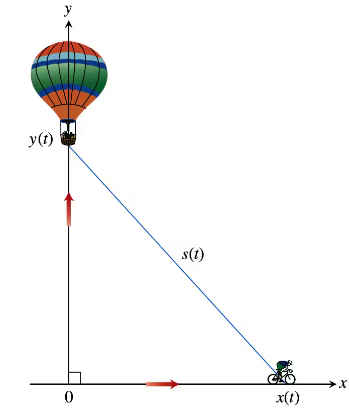
A balloon and a bicycle A balloon is rising vertically above a level, straight road at a constant rate of 1 ft/sec. Just when the balloon is 65 ft above the ground, a bicycle moving at a constant rate of 17 ft/sec passes under it. How fast is the distance s(t) between the bicycle and the balloon increasing 3 sec later?
A hot air balloon rises vertically while a bicycle moves horizontally below it, illustrating related rates in calculus.

Guida verificata passo dopo passo
1
Identify the variables: Let y(t) be the height of the balloon above the ground, x(t) be the horizontal distance of the bicycle from the point directly below the balloon, and s(t) be the distance between the balloon and the bicycle.
Write the given rates: The balloon rises at a rate of 1 ft/sec, so dy/dt = 1 ft/sec. The bicycle moves at a rate of 17 ft/sec, so dx/dt = 17 ft/sec.
Use the Pythagorean theorem to relate the distances: s(t)^2 = x(t)^2 + y(t)^2. Differentiate both sides with respect to time t to find the rate of change of s(t).
Differentiate: 2s(t) * ds/dt = 2x(t) * dx/dt + 2y(t) * dy/dt. Simplify to find ds/dt, the rate at which the distance between the balloon and the bicycle is increasing.
Substitute the known values: At t = 3 seconds, y(t) = 65 + 3*1 = 68 ft, x(t) = 3*17 = 51 ft. Use these values to solve for ds/dt.

Risposta video verificata per un problema simile:

Questa soluzione video è stata consigliata dai nostri tutor come utile per risolvere questo problema.
Durata del video:
7m

Concetti chiave

Ecco i concetti essenziali che devi comprendere per rispondere correttamente alla domanda.

Related Rates

Related rates involve finding the rate at which one quantity changes with respect to another. In this problem, we need to determine how fast the distance between the balloon and the bicycle changes over time. This requires understanding how the rates of change of the vertical and horizontal positions relate to the rate of change of the distance between them.
Video consigliato:
Percorso guidato
04:16
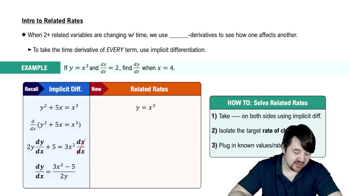
Intro To Related Rates

Pythagorean Theorem

The Pythagorean Theorem is essential for relating the vertical and horizontal distances to the hypotenuse, which is the distance s(t) between the balloon and the bicycle. Given the vertical distance y(t) and horizontal distance x(t), the theorem states that s(t)^2 = y(t)^2 + x(t)^2, allowing us to express s(t) in terms of y(t) and x(t).
Video consigliato:
Percorso guidato
06:11
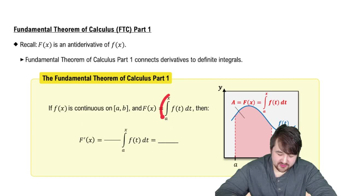
Fundamental Theorem of Calculus Part 1

Differentiation

Differentiation is used to find the rate of change of a function. In this context, we differentiate the equation s(t)^2 = y(t)^2 + x(t)^2 with respect to time to find ds/dt, the rate at which the distance between the balloon and the bicycle changes. This involves applying the chain rule to differentiate each term with respect to time.
Video consigliato:
Percorso guidato
05:53
Finding Differentials