
Ch. 3 - Derivatives
Hass - Thomas' Calculus 15th Edition
Hass15th EditionThomas' CalculusISBN: 9780137616077Non è quello che usi tu?Cambia libro di testo
Capitolo 3, Problema 3.3.9

Derivative Calculations


In Exercises 1–12, find the first and second derivatives.


y = 6x² − 10x − 5x⁻²

Guida verificata passo dopo passo
1
Step 1: Identify the function y = 6x² − 10x − 5x⁻². We need to find the first derivative, which involves differentiating each term separately.
Step 2: Differentiate the first term 6x². Using the power rule, the derivative of x^n is n*x^(n-1). Therefore, the derivative of 6x² is 12x.
Step 3: Differentiate the second term -10x. The derivative of x is 1, so the derivative of -10x is -10.
Step 4: Differentiate the third term -5x⁻². Again, using the power rule, the derivative of x⁻² is -2*x⁻³. Therefore, the derivative of -5x⁻² is 10x⁻³.
Step 5: Combine the derivatives from steps 2, 3, and 4 to find the first derivative: y' = 12x - 10 + 10x⁻³. To find the second derivative, differentiate y' using the same rules applied to each term.

Risposta video verificata per un problema simile:

Questa soluzione video è stata consigliata dai nostri tutor come utile per risolvere questo problema.
Durata del video:
2m

Concetti chiave

Ecco i concetti essenziali che devi comprendere per rispondere correttamente alla domanda.

Derivative

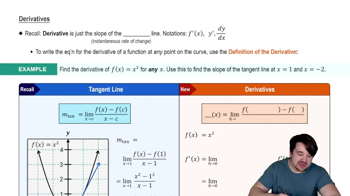
A derivative represents the rate of change of a function with respect to a variable. It is a fundamental concept in calculus that provides information about the slope of the tangent line to the curve of the function at any given point. The first derivative indicates how the function is changing, while the second derivative provides insight into the curvature or concavity of the function.
Video consigliato:

Power Rule

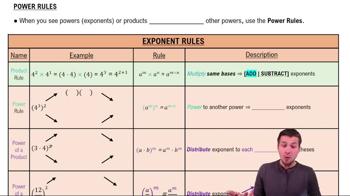
The Power Rule is a basic differentiation technique used to find the derivative of functions in the form of ax^n, where a is a constant and n is a real number. According to this rule, the derivative is calculated by multiplying the coefficient by the exponent and then reducing the exponent by one. This rule simplifies the process of finding derivatives for polynomial functions, making it essential for solving problems involving such expressions.
Video consigliato:
5:50
Power Rules

Concavity and Inflection Points

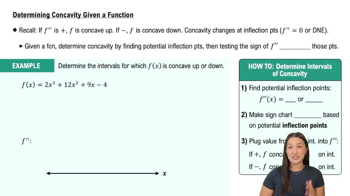
Concavity refers to the direction in which a function curves, determined by the sign of the second derivative. If the second derivative is positive, the function is concave up, and if it is negative, the function is concave down. Inflection points occur where the concavity changes, which can be identified by setting the second derivative equal to zero. Understanding concavity is crucial for analyzing the behavior of functions and their graphs.
Video consigliato:
05:59
Determining Concavity Given a Function