

Ch. 3 - Derivatives
Hass - Thomas' Calculus 15th Edition
Hass15th EditionThomas' CalculusISBN: 9780137616077Non è quello che usi tu?Cambia libro di testo
Capitolo 3, Problema 3.5.53b

By computing the first few derivatives and looking for a pattern, find the following derivatives.


b. d¹¹⁰/dx¹¹⁰ (sin x − 3 cos x)

Guida verificata passo dopo passo
1
First, identify the function for which we need to find the 110th derivative: f(x) = sin(x) - 3cos(x).
Compute the first derivative: f'(x) = cos(x) + 3sin(x).
Compute the second derivative: f''(x) = -sin(x) + 3cos(x).
Compute the third derivative: f'''(x) = -cos(x) - 3sin(x).
Observe the pattern in the derivatives: The derivatives repeat every four steps. Use this pattern to determine the 110th derivative by finding the remainder of 110 divided by 4.

Risposta video verificata per un problema simile:

Questa soluzione video è stata consigliata dai nostri tutor come utile per risolvere questo problema.
Durata del video:
3m

Concetti chiave

Ecco i concetti essenziali che devi comprendere per rispondere correttamente alla domanda.

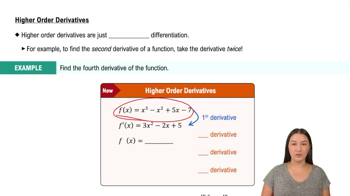
Higher Order Derivatives

Higher order derivatives refer to the derivatives of a function taken multiple times. For example, the second derivative is the derivative of the first derivative. In this problem, you need to compute the 110th derivative, which involves identifying a pattern in the derivatives of the given function.
Video consigliato:
02:42
Higher Order Derivatives

Trigonometric Derivatives

Understanding the derivatives of trigonometric functions is crucial. The derivative of sin(x) is cos(x), and the derivative of cos(x) is -sin(x). These derivatives repeat in a cycle, which is key to identifying patterns when computing higher order derivatives of trigonometric expressions.
Video consigliato:
06:35
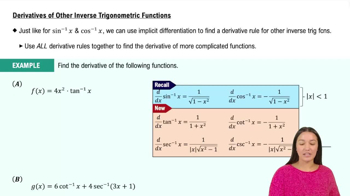
Derivatives of Other Inverse Trigonometric Functions

Pattern Recognition in Derivatives

When computing higher order derivatives, recognizing patterns can simplify the process. For trigonometric functions, derivatives often repeat in cycles. By calculating the first few derivatives, you can identify the cycle length and predict the 110th derivative without computing each one individually.
Video consigliato:
Pratica correlata
Domanda del libro di testo

Average single-family home prices P (in thousands of dollars) in Sacramento, California, are shown in the accompanying figure from the beginning of 2006 through the end of 2015.


b. Estimate home prices at the end of

i) 2007 ii) 2012 iii) 2015

237
views
Domanda del libro di testo

Motion Along a Coordinate Line


Exercises 1–6 give the positions s = f(t) of a body moving on a coordinate line, with s in meters and t in seconds.


b. Find the body’s speed and acceleration at the endpoints of the interval.


s = 25/t² − 5/t, 1 ≤ t ≤ 5

207
views
Domanda del libro di testo

A sliding ladder


A 13-ft ladder is leaning against a house when its base starts to slide away. By the time the base is 12 ft from the house, the base is moving at the rate of 5 ft/sec.


b. At what rate is the area of the triangle formed by the ladder, wall, and ground changing then?


435
views
Domanda del libro di testo

Quadratic approximations


b. Find the quadratic approximation to f(x) = 1/(1 − x) at x = 0.

183
views
Domanda del libro di testo

Hauling in a dinghy A dinghy is pulled toward a dock by a rope from the bow through a ring on the dock 6 ft above the bow. The rope is hauled in at the rate of 2 ft/sec.


b. At what rate is the angle θ changing at this instant (see the figure)?

248
views
Domanda del libro di testo

Temperature The given graph shows the outside temperature T in °F, between 6 a.m. and 6 p.m.

b. At what time does the temperature increase most rapidly? Decrease most rapidly? What is the rate for each of those times?

238
views