
Domanda del libro di testo
The radius r of a circle is measured with an error of at most 2%. What is the maximum corresponding percentage error in computing the circle’s
b. area?
259
views

 Guida verificata passo dopo passo
 05:14
05:14
 05:02
05:02 04:50
04:50The radius r of a circle is measured with an error of at most 2%. What is the maximum corresponding percentage error in computing the circle’s
b. area?
Suppose that functions ƒ(x) and g(x) and their first derivatives have the following values at x = 0 and x = 1.
x ƒ(x) g(x) ƒ'(x) g'(x)
0 1 1 -3 1/2
1 3 5 1/2 -4
Find the first derivatives of the following combinations at the given value of x.
c. ƒ(x) , x = 1
g(x) + 1
Computer Explorations
Use a CAS to perform the following steps in Exercises 55–62.
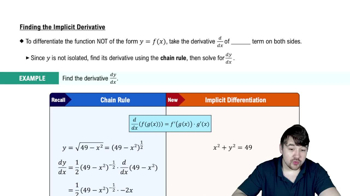
b. Using implicit differentiation, find a formula for the derivative dy/dx and evaluate it at the given point P.
x√(1 + 2y) + y = x², P(1,0)
The folium of Descartes (See Figure 3.27)
c. Find the coordinates of the point A in Figure 3.29 where the folium has a vertical tangent line.
Area The area A of a triangle with sides of lengths a and b enclosing an angle of measure θ is
A = (1/2) ab sinθ.
b. How is dA/dt related to dθ/dt and da/dt if only b is constant?
Differentiability and Continuity on an Interval
Each figure in Exercises 45–50 shows the graph of a function over a closed interval D. At what domain points does the function appear to be
c. neither continuous nor differentiable?
Give reasons for your answers.