
Ch. 3 - Derivatives
Hass - Thomas' Calculus 15th Edition
Hass15th EditionThomas' CalculusISBN: 9780137616077Non è quello che usi tu?Cambia libro di testo
Capitolo 3, Problema 3.57c

Suppose that functions ƒ(x) and g(x) and their first derivatives have the following values at x = 0 and x = 1.


x ƒ(x) g(x) ƒ'(x) g'(x)
0 1 1 -3 1/2
1 3 5 1/2 -4


Find the first derivatives of the following combinations at the given value of x.


c. ƒ(x) , x = 1
g(x) + 1

Guida verificata passo dopo passo
1
Identify the function combination for which you need to find the derivative. In this case, it is the derivative of the function f(x) with respect to x, evaluated at x = 1.
Recall that the derivative of a function at a point gives the rate of change of the function at that point. Here, you need to find f'(x) at x = 1.
From the given data, locate the value of f'(x) at x = 1. According to the table, f'(1) = 1/2.
Since the problem asks for the derivative of f(x) at x = 1, and you have already identified f'(1) = 1/2, this is the value you need.
Thus, the first derivative of f(x) at x = 1 is 1/2, which represents the slope of the tangent line to the curve of f(x) at that point.

Risposta video verificata per un problema simile:

Questa soluzione video è stata consigliata dai nostri tutor come utile per risolvere questo problema.
Durata del video:
4m

Concetti chiave

Ecco i concetti essenziali che devi comprendere per rispondere correttamente alla domanda.

Derivative of a Function

The derivative of a function measures how the function's output changes as its input changes. It is defined as the limit of the average rate of change of the function over an interval as the interval approaches zero. In this context, knowing the derivatives of functions ƒ(x) and g(x) at specific points is crucial for finding the derivatives of their combinations.
Video consigliato:
06:30
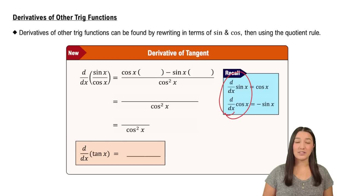
Derivatives of Other Trig Functions

Sum Rule of Derivatives

The sum rule states that the derivative of the sum of two functions is equal to the sum of their derivatives. Mathematically, if h(x) = ƒ(x) + g(x), then h'(x) = ƒ'(x) + g'(x). This rule is essential for solving the given problem, as it allows us to find the derivative of the combination ƒ(x) + 1 by simply using the derivative of ƒ(x) since the derivative of a constant (1) is zero.
Video consigliato:
Percorso guidato
05:44
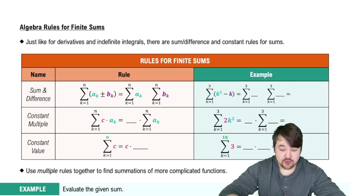
Algebra Rules for Finite Sums

Evaluating Derivatives at Specific Points

Evaluating a derivative at a specific point involves substituting the value of x into the derivative function. In this case, we need to find the derivative of the combination at x = 1. This requires using the provided values of the derivatives at that point to compute the final result accurately.
Video consigliato:
04:50
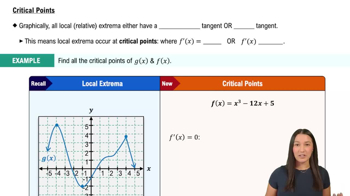
Critical Points