Ch. 3 - Derivatives
Hass - Thomas' Calculus 15th Edition
Hass15th EditionThomas' CalculusISBN: 9780137616077Non è quello che usi tu?Cambia libro di testo
Capitolo 3, Problema 3.3.4

Derivative Calculations


In Exercises 1–12, find the first and second derivatives.


w = 3z⁷ − 7z³ + 21z²

Guida verificata passo dopo passo
1
Step 1: Identify the function for which you need to find the derivatives. Here, the function is \( w = 3z^7 - 7z^3 + 21z^2 \).
Step 2: To find the first derivative, apply the power rule to each term of the function. The power rule states that the derivative of \( z^n \) is \( nz^{n-1} \).
Step 3: Calculate the first derivative \( \frac{dw}{dz} \) by applying the power rule: \( \frac{d}{dz}(3z^7) = 21z^6 \), \( \frac{d}{dz}(-7z^3) = -21z^2 \), and \( \frac{d}{dz}(21z^2) = 42z \). Combine these results to get the first derivative.
Step 4: To find the second derivative, apply the power rule again to the first derivative. Differentiate each term of the first derivative.
Step 5: Calculate the second derivative \( \frac{d^2w}{dz^2} \) by applying the power rule to each term of the first derivative obtained in Step 3. Combine these results to get the second derivative.

Risposta video verificata per un problema simile:

Questa soluzione video è stata consigliata dai nostri tutor come utile per risolvere questo problema.
Durata del video:
3m

Concetti chiave

Ecco i concetti essenziali che devi comprendere per rispondere correttamente alla domanda.

Derivative

A derivative represents the rate of change of a function with respect to a variable. It is a fundamental concept in calculus that measures how a function's output value changes as its input value changes. The first derivative of a function provides information about its slope, while the second derivative gives insight into the function's concavity and acceleration.
Video consigliato:

Power Rule

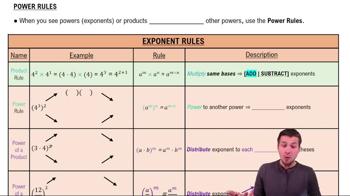
The Power Rule is a basic differentiation rule used to find the derivative of functions in the form of ax^n, where a is a constant and n is a real number. According to this rule, the derivative is calculated by multiplying the coefficient by the exponent and then reducing the exponent by one. This rule simplifies the process of finding derivatives for polynomial functions.
Video consigliato:
5:50
Power Rules

Higher-Order Derivatives

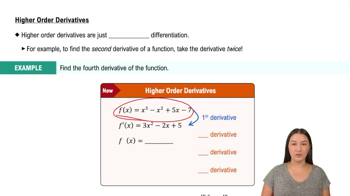
Higher-order derivatives refer to the derivatives of a function taken multiple times. The first derivative gives the rate of change, the second derivative provides information about the curvature of the graph, and further derivatives can indicate more complex behaviors of the function. Understanding higher-order derivatives is essential for analyzing the behavior of functions in greater detail.
Video consigliato:
02:42
Higher Order Derivatives