Ch. 3 - Derivatives
Hass - Thomas' Calculus 15th Edition
Hass15th EditionThomas' CalculusISBN: 9780137616077Non è quello che usi tu?Cambia libro di testo
Capitolo 3, Problema 3.9.38

Differential Estimates of Change


In Exercises 35–40, write a differential formula that estimates the given change in volume or surface area.


The change in the lateral surface area S = πr√(r² + h²) of a right circular cone when the radius changes from r₀ to r₀ + dr and the height does not change

Guida verificata passo dopo passo
1
Identify the formula for the lateral surface area of a right circular cone: \( S = \pi r \sqrt{r^2 + h^2} \).
Recognize that the problem asks for the change in the lateral surface area when the radius changes from \( r_0 \) to \( r_0 + dr \), while the height \( h \) remains constant.
To estimate the change in \( S \), use the concept of differentials. The differential \( dS \) is given by the derivative of \( S \) with respect to \( r \), multiplied by \( dr \).
Calculate the derivative \( \frac{dS}{dr} \) using the product rule and chain rule: \( \frac{dS}{dr} = \pi \left( \sqrt{r^2 + h^2} + \frac{r^2}{\sqrt{r^2 + h^2}} \right) \).
The differential formula that estimates the change in the lateral surface area is \( dS = \pi \left( \sqrt{r^2 + h^2} + \frac{r^2}{\sqrt{r^2 + h^2}} \right) dr \).

Risposta video verificata per un problema simile:

Questa soluzione video è stata consigliata dai nostri tutor come utile per risolvere questo problema.
Durata del video:
1m

Concetti chiave

Ecco i concetti essenziali che devi comprendere per rispondere correttamente alla domanda.

Differential Calculus

Differential calculus focuses on the concept of the derivative, which represents the rate of change of a function. In this context, it is used to estimate how small changes in the radius of a cone affect its lateral surface area, assuming the height remains constant.
Video consigliato:
Percorso guidato
06:11
Fundamental Theorem of Calculus Part 1

Lateral Surface Area of a Cone

The lateral surface area of a right circular cone is given by the formula S = πr√(r² + h²), where r is the radius and h is the height. Understanding this formula is crucial for determining how changes in the radius impact the surface area when the height is fixed.
Video consigliato:
09:07
Example 1: Minimizing Surface Area

Differential Formula

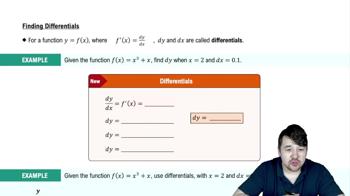
A differential formula is used to approximate the change in a function's value due to small changes in its variables. For the cone's surface area, the differential formula involves calculating the derivative of the surface area with respect to the radius, providing an estimate of the change when the radius increases by a small amount dr.
Video consigliato:
Percorso guidato
05:53
Finding Differentials