Ch. 3 - Derivatives
Hass - Thomas' Calculus 15th Edition
Hass15th EditionThomas' CalculusISBN: 9780137616077Non è quello che usi tu?Cambia libro di testo
Capitolo 3, Problema 3.6.77

Find ds/dt when θ = 3π/2 if s = cosθ and dθ/dt = 5.

Guida verificata passo dopo passo
1
Identify the given function: s = cos(θ). We need to find ds/dt, the rate of change of s with respect to time.
Use the chain rule for differentiation, which states that ds/dt = (ds/dθ) * (dθ/dt).
Differentiate s = cos(θ) with respect to θ to find ds/dθ. The derivative of cos(θ) is -sin(θ), so ds/dθ = -sin(θ).
Substitute the given value of dθ/dt = 5 into the chain rule expression: ds/dt = -sin(θ) * 5.
Evaluate -sin(θ) at θ = 3π/2. Since sin(3π/2) = -1, substitute this value into the expression to find ds/dt.

Risposta video verificata per un problema simile:

Questa soluzione video è stata consigliata dai nostri tutor come utile per risolvere questo problema.
Durata del video:
2m

Concetti chiave

Ecco i concetti essenziali che devi comprendere per rispondere correttamente alla domanda.

Chain Rule

The chain rule is a fundamental concept in calculus used to differentiate composite functions. It states that if a variable y depends on u, which in turn depends on x, then the derivative of y with respect to x is the product of the derivative of y with respect to u and the derivative of u with respect to x. In this problem, it helps find ds/dt by relating ds/dθ and dθ/dt.
Video consigliato:
05:02
Intro to the Chain Rule

Trigonometric Derivatives

Understanding the derivatives of trigonometric functions is crucial for solving calculus problems involving these functions. The derivative of cos(θ) with respect to θ is -sin(θ). This knowledge is essential for finding ds/dθ when s = cos(θ), which is a step in applying the chain rule to find ds/dt.
Video consigliato:
06:35
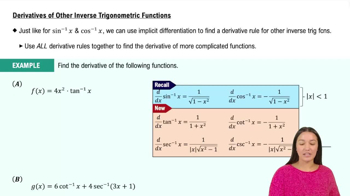
Derivatives of Other Inverse Trigonometric Functions

Evaluating Trigonometric Functions

Evaluating trigonometric functions at specific angles is necessary for solving problems involving these functions. At θ = 3π/2, the value of sin(θ) is -1. This evaluation is crucial for determining the value of ds/dθ at the given angle, which is then used to find ds/dt using the chain rule.
Video consigliato:
Percorso guidato
6:04
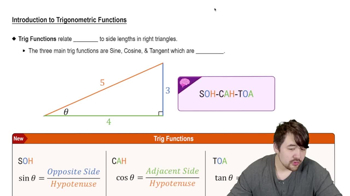
Introduction to Trigonometric Functions