
Domanda del libro di testo
In Exercises 83–88, find equations for the lines that are tangent, and the lines that are normal, to the curve at the given point.
xy + 2x - 5y = 2, (3, 2)
317
views

 Guida verificata passo dopo passo
 05:14
05:14
 05:02
05:02 05:18
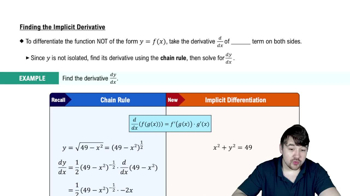
05:18In Exercises 83–88, find equations for the lines that are tangent, and the lines that are normal, to the curve at the given point.
xy + 2x - 5y = 2, (3, 2)
Slopes on the graph of the tangent function Graph y = tan x and its derivative together on (−π/2, π/2). Does the graph of the tangent function appear to have a smallest slope? A largest slope? Is the slope ever negative? Give reasons for your answers.
The devil’s curve (Gabriel Cramer, 1750) Find the slopes of the devil’s curve y⁴ – 4y² = x⁴ – 9x² at the four indicated points.
For Exercises 55 and 56, evaluate each limit by first converting each to a derivative at a particular x-value.
lim (x → −1) (x²/⁹ − 1) / (x + 1)
Normal lines to a parabola Show that if it is possible to draw three normal lines from the point (a, 0) to the parabola x = y² shown in the accompanying diagram, then a must be greater than 1/2. One of the normal lines is the x-axis. For what value of a are the other two normal lines perpendicular?
<IMAGE>
In Exercises 83–88, find equations for the lines that are tangent, and the lines that are normal, to the curve at the given point.
x³/² + 2y³/² = 17, (1, 4)