Ch. 3 - Derivatives
Hass - Thomas' Calculus 15th Edition
Hass15th EditionThomas' CalculusISBN: 9780137616077Non è quello che usi tu?Cambia libro di testo
Capitolo 3, Problema 3.5.61

Slopes on the graph of the tangent function Graph y = tan x and its derivative together on (−π/2, π/2). Does the graph of the tangent function appear to have a smallest slope? A largest slope? Is the slope ever negative? Give reasons for your answers.

Guida verificata passo dopo passo
1
Graph the function \( y = \tan(x) \) on the interval \( (-\pi/2, \pi/2) \). Note that the tangent function has vertical asymptotes at \( x = -\pi/2 \) and \( x = \pi/2 \), and it is undefined at these points.
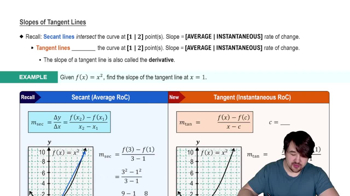
Find the derivative of \( y = \tan(x) \). The derivative is \( y' = \sec^2(x) \), which represents the slope of the tangent line to the graph of \( \tan(x) \) at any point where it is defined.
Analyze the behavior of \( y' = \sec^2(x) \) on the interval \( (-\pi/2, \pi/2) \). Since \( \sec^2(x) \) is always positive and increases without bound as \( x \) approaches \( \pm\pi/2 \), the slope of the tangent function becomes arbitrarily large near these points.
Determine whether the slope is ever negative. Since \( \sec^2(x) > 0 \) for all \( x \) in \( (-\pi/2, \pi/2) \), the slope of the tangent function is never negative on this interval.
Conclude that the graph of the tangent function does not have a smallest or largest slope because \( \sec^2(x) \) increases without bound as \( x \) approaches \( \pm\pi/2 \). The slope is always positive and becomes arbitrarily large near the vertical asymptotes.

Risposta video verificata per un problema simile:

Questa soluzione video è stata consigliata dai nostri tutor come utile per risolvere questo problema.
Durata del video:
5m

Concetti chiave

Ecco i concetti essenziali che devi comprendere per rispondere correttamente alla domanda.

Tangent Function Behavior

The tangent function, defined as y = tan(x), has a periodic nature with vertical asymptotes at odd multiples of π/2. Within the interval (−π/2, π/2), the function increases from negative infinity to positive infinity, which affects the slopes of its tangent lines. Understanding this behavior is crucial for analyzing the slopes of the tangent function.
Video consigliato:
Percorso guidato
05:13
Slopes of Tangent Lines

Derivative of the Tangent Function

The derivative of the tangent function, given by y' = sec²(x), indicates the slope of the tangent line at any point on the graph. Since sec²(x) is always positive for x in (−π/2, π/2), the slope of the tangent function is never negative in this interval. This concept is essential for determining the nature of slopes on the graph.
Video consigliato:
Percorso guidato
05:13
Slopes of Tangent Lines

Limits and Asymptotic Behavior

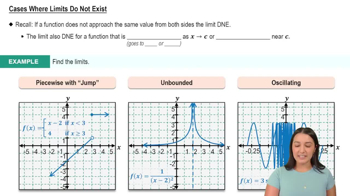
As x approaches the vertical asymptotes of the tangent function at −π/2 and π/2, the function's values approach negative and positive infinity, respectively. This behavior implies that the slopes of the tangent function also approach infinity near these asymptotes. Understanding limits helps in identifying the largest and smallest slopes within the specified interval.
Video consigliato:
03:07
Cases Where Limits Do Not Exist