
Ch. 3 - Derivatives
Hass - Thomas' Calculus 15th Edition
Hass15th EditionThomas' CalculusISBN: 9780137616077Non è quello che usi tu?Cambia libro di testo
Capitolo 3, Problema 21a

Economics


Marginal cost Suppose that the dollar cost of producing x washing machines is c(x) = 2000 + 100x − 0.1x².


a. Find the average cost per machine of producing the first 100 washing machines.

Guida verificata passo dopo passo
1
First, understand the given cost function: c(x) = 2000 + 100x - 0.1x², where c(x) represents the total cost of producing x washing machines.
To find the average cost per machine for the first 100 machines, we need to calculate the total cost for producing 100 machines, which is c(100).
Substitute x = 100 into the cost function: c(100) = 2000 + 100(100) - 0.1(100)².
Calculate c(100) to find the total cost of producing 100 machines.
Finally, divide the total cost c(100) by 100 to find the average cost per machine: Average cost = c(100) / 100.

Risposta video verificata per un problema simile:

Questa soluzione video è stata consigliata dai nostri tutor come utile per risolvere questo problema.
Durata del video:
2m

Concetti chiave

Ecco i concetti essenziali che devi comprendere per rispondere correttamente alla domanda.

Average Cost

Average cost is calculated by dividing the total cost by the number of units produced. It provides insight into the cost efficiency of production. For the given function c(x), the average cost per machine for producing x washing machines is c(x)/x, which helps determine the cost per unit for a specific production level.
Video consigliato:
Percorso guidato
06:37
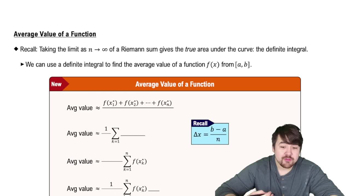
Average Value of a Function

Cost Function

A cost function, such as c(x) = 2000 + 100x − 0.1x², represents the total cost of producing x units. It includes fixed costs, variable costs, and sometimes quadratic terms that account for changes in cost efficiency. Understanding this function is crucial for calculating total and average costs at different production levels.
Video consigliato:
Percorso guidato
06:21
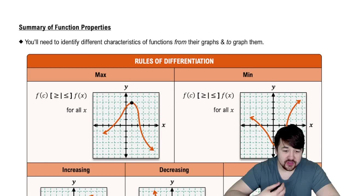
Properties of Functions

Quadratic Functions

Quadratic functions are polynomial functions of degree two, typically in the form ax² + bx + c. In economics, they can model cost functions where the cost changes non-linearly with production levels. The term −0.1x² in the cost function indicates diminishing returns or increasing inefficiencies as production increases, affecting the average cost calculation.
Video consigliato:
6:04
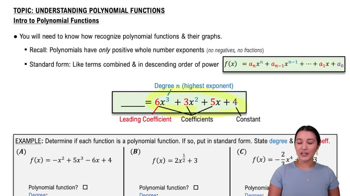
Introduction to Polynomial Functions