

Ch. 3 - Derivatives
Hass - Thomas' Calculus 15th Edition
Hass15th EditionThomas' CalculusISBN: 9780137616077Non è quello che usi tu?Cambia libro di testo
Capitolo 3, Problema 21c

Economics


Marginal cost Suppose that the dollar cost of producing x washing machines is c(x) = 2000 + 100x − 0.1x².


c. Show that the marginal cost when 100 washing machines are produced is approximately the cost of producing one more washing machine after the first 100 have been made, by calculating the latter cost directly.

Guida verificata passo dopo passo
1
First, understand that the marginal cost is the derivative of the cost function c(x) with respect to x. This represents the rate of change of the cost with respect to the number of washing machines produced.
Calculate the derivative of the cost function c(x) = 2000 + 100x - 0.1x². The derivative, c'(x), will give us the marginal cost function.
Differentiate c(x) with respect to x: c'(x) = d/dx [2000 + 100x - 0.1x²]. Use the power rule for differentiation: the derivative of a constant is 0, the derivative of 100x is 100, and the derivative of -0.1x² is -0.2x.
Substitute x = 100 into the marginal cost function c'(x) to find the marginal cost when 100 washing machines are produced. This will give us c'(100).
To verify, calculate the cost of producing the 101st washing machine directly by finding the difference: c(101) - c(100). Compare this value to c'(100) to show that the marginal cost approximates the cost of producing one more washing machine after the first 100.

Risposta video verificata per un problema simile:

Questa soluzione video è stata consigliata dai nostri tutor come utile per risolvere questo problema.
Durata del video:
3m

Concetti chiave

Ecco i concetti essenziali che devi comprendere per rispondere correttamente alla domanda.

Marginal Cost

Marginal cost refers to the additional cost incurred in producing one more unit of a good. It is derived from the cost function and is crucial for understanding how costs change with production levels. In calculus, it is represented as the derivative of the cost function with respect to the quantity produced, providing an instantaneous rate of change of cost.
Video consigliato:
07:32
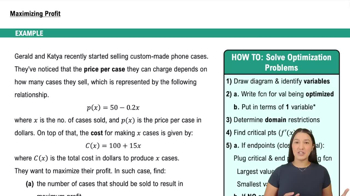
Example 3: Maximizing Profit

Derivative

The derivative of a function at a point measures the rate at which the function's value changes as its input changes. In the context of cost functions, the derivative represents the marginal cost, indicating how the total cost changes with a small change in the number of units produced. Calculating the derivative of the cost function c(x) gives the marginal cost function.
Video consigliato:

Evaluating the Derivative at a Point

To find the marginal cost at a specific production level, evaluate the derivative of the cost function at that point. This involves substituting the given production quantity into the marginal cost function. For example, to find the marginal cost when 100 washing machines are produced, substitute x = 100 into the derivative of c(x) to determine the cost of producing one additional unit.
Video consigliato:
04:50
Critical Points
Pratica correlata
Domanda del libro di testo

Economics


Marginal revenue

Suppose that the revenue from selling x washing machines is


r(x) = 20000(1 − 1/x) dollars.


b. Use the function r'(x) to estimate the increase in revenue that will result from increasing production from 100 machines a week to 101 machines a week.

203
views
Domanda del libro di testo

Economics


Marginal revenue

Suppose that the revenue from selling x washing machines is


r(x) = 20000(1 − 1/x) dollars.


c. Find the limit of r'(x) as x → ∞. How would you interpret this number?

192
views
Domanda del libro di testo

Economics


Marginal cost Suppose that the dollar cost of producing x washing machines is c(x) = 2000 + 100x − 0.1x².


a. Find the average cost per machine of producing the first 100 washing machines.

198
views
Domanda del libro di testo

Understanding Motion from Graphs


The accompanying figure shows the velocity v = f(t) of a particle moving on a horizontal coordinate line.


d. When does the particle stand still for more than an instant?

247
views
Domanda del libro di testo

In Exercises 19–22, find the values of the derivatives.


dr/dθ |θ₌₀ if r = 2/√(4 – θ)

151
views
Domanda del libro di testo

Additional Applications


Bacterium population

When a bactericide was added to a nutrient broth in which bacteria were growing, the bacterium population continued to grow for a while, but then stopped growing and began to decline. The size of the population at time t (hours) was b = 10⁶ + 10⁴t − 10³t². Find the growth rates at


a. t = 0 hours.

b. t = 5 hours.

c. t = 10 hours.

217
views