

Ch. 3 - Derivatives
Hass - Thomas' Calculus 15th Edition
Hass15th EditionThomas' CalculusISBN: 9780137616077Non è quello che usi tu?Cambia libro di testo
Capitolo 3, Problema 3.6.89

Falling meteorite The velocity of a heavy meteorite entering Earth’s atmosphere is inversely proportional to √s when it is s km from Earth’s center. Show that the meteorite’s acceleration is inversely proportional to s².

Guida verificata passo dopo passo
1
Start by expressing the given relationship: the velocity v of the meteorite is inversely proportional to the square root of s, which can be written as v = k/√s, where k is a constant.
To find acceleration, recall that acceleration a is the derivative of velocity v with respect to time t. However, since v is given as a function of s, we need to use the chain rule to express a in terms of s.
Apply the chain rule: a = dv/dt = (dv/ds) * (ds/dt). Here, ds/dt is the velocity v itself, so a = (dv/ds) * v.
Differentiate v = k/√s with respect to s to find dv/ds. This gives dv/ds = -k/(2s^(3/2)).
Substitute dv/ds and v into the expression for acceleration: a = (-k/(2s^(3/2))) * (k/√s) = -k²/(2s²). This shows that the acceleration a is inversely proportional to s².

Risposta video verificata per un problema simile:

Questa soluzione video è stata consigliata dai nostri tutor come utile per risolvere questo problema.
Durata del video:
5m

Concetti chiave

Ecco i concetti essenziali che devi comprendere per rispondere correttamente alla domanda.

Inverse Proportionality

Inverse proportionality describes a relationship where one quantity increases as another decreases. In this context, the meteorite's velocity is inversely proportional to the square root of the distance from Earth's center, meaning as the distance decreases, the velocity increases. Understanding this relationship is crucial for analyzing how changes in distance affect velocity.
Video consigliato:
4:49
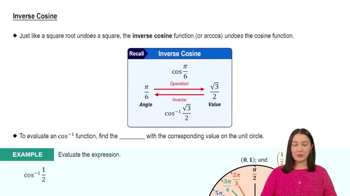
Inverse Cosine

Differentiation

Differentiation is a fundamental concept in calculus used to determine the rate at which a function changes. To find the acceleration of the meteorite, which is the derivative of velocity with respect to time, we apply differentiation to the velocity function. This process helps us understand how the velocity changes as the meteorite moves closer to Earth.
Video consigliato:
Percorso guidato
05:53
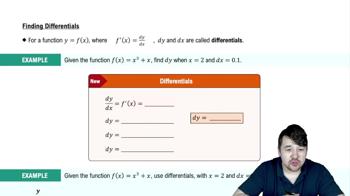
Finding Differentials

Chain Rule

The chain rule is a technique in calculus for differentiating composite functions. In this problem, it is used to differentiate the velocity function with respect to distance, and then relate it to acceleration. By applying the chain rule, we can express acceleration in terms of distance, showing its inverse proportionality to the square of the distance.
Video consigliato:
05:02
Intro to the Chain Rule