

Ch. 3 - Derivatives
Hass - Thomas' Calculus 15th Edition
Hass15th EditionThomas' CalculusISBN: 9780137616077Non è quello che usi tu?Cambia libro di testo
Capitolo 3, Problema 3.1.43

[Technology Exercise]


Graph the curves in Exercises 39–48.
a. Where do the graphs appear to have vertical tangent lines?
b. Confirm your findings in part (a) with limit calculations. But before you do, read the introduction to Exercises 37 and 38.


y = 4x²/⁵ − 2x

Guida verificata passo dopo passo
1
Step 1: Begin by understanding the concept of a vertical tangent line. A vertical tangent occurs where the derivative of the function is undefined or infinite. For the function y = 4x^(2/5) - 2x, we need to find its derivative.
Step 2: Differentiate the function y = 4x^(2/5) - 2x with respect to x. Use the power rule for differentiation: if y = x^n, then dy/dx = n*x^(n-1). Apply this to each term in the function.
Step 3: The derivative of y = 4x^(2/5) is (2/5)*4*x^((2/5)-1) = (8/5)*x^(-3/5). The derivative of -2x is simply -2. Therefore, the derivative of the function is dy/dx = (8/5)*x^(-3/5) - 2.
Step 4: Identify where the derivative dy/dx = (8/5)*x^(-3/5) - 2 is undefined or infinite. This occurs when x^(-3/5) is undefined, which happens when x = 0. Thus, x = 0 is a candidate for a vertical tangent line.
Step 5: Confirm the vertical tangent by calculating the limit of the derivative as x approaches 0. Evaluate the limit of (8/5)*x^(-3/5) - 2 as x approaches 0 from the left and right. If the limit approaches infinity or negative infinity, a vertical tangent exists at x = 0.

Risposta video verificata per un problema simile:

Questa soluzione video è stata consigliata dai nostri tutor come utile per risolvere questo problema.
Durata del video:
1m

Concetti chiave

Ecco i concetti essenziali che devi comprendere per rispondere correttamente alla domanda.

Vertical Tangent Lines

Vertical tangent lines occur at points on a curve where the derivative is undefined or infinite. This typically happens when the slope of the tangent line becomes vertical, indicating a sharp turn or cusp in the graph. Identifying these points requires analyzing the behavior of the derivative as it approaches certain values.
Video consigliato:
Percorso guidato
05:13
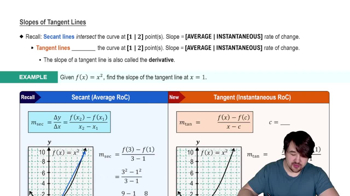
Slopes of Tangent Lines

Limit Calculations

Limit calculations are used to determine the behavior of a function as it approaches a specific point. In the context of vertical tangents, limits help confirm where the derivative becomes infinite or undefined. Calculating limits involves evaluating the function's behavior as the input approaches the point of interest, often using algebraic manipulation or L'Hôpital's Rule.
Video consigliato:
05:50
One-Sided Limits

Derivative of a Function

The derivative of a function represents the rate of change or slope of the function at any given point. For the function y = 4x²/⁵ − 2x, finding the derivative involves applying differentiation rules, such as the power rule, to each term. The derivative is crucial for identifying tangent lines and understanding the function's behavior, especially in determining where vertical tangents may occur.
Video consigliato:
06:30
Derivatives of Other Trig Functions