Ch. 3 - Derivatives
Hass - Thomas' Calculus 15th Edition
Hass15th EditionThomas' CalculusISBN: 9780137616077Non è quello che usi tu?Cambia libro di testo
Capitolo 3, Problema 3.2.41

In Exercises 41–44, determine whether the piecewise-defined function is differentiable at x = 0.


f(x) = { 2x − 1, x ≥ 0
x² + 2x + 7, x < 0

Guida verificata passo dopo passo
1
First, check the continuity of the function at x = 0. Evaluate the left-hand limit and the right-hand limit of f(x) as x approaches 0. For x ≥ 0, f(x) = 2x - 1, so the right-hand limit as x approaches 0 is f(0) = 2(0) - 1 = -1. For x < 0, f(x) = x² + 2x + 7, so the left-hand limit as x approaches 0 is f(0) = 0² + 2(0) + 7 = 7.
Since the left-hand limit (7) and the right-hand limit (-1) are not equal, the function is not continuous at x = 0. A function must be continuous at a point to be differentiable there.
Even though the function is not continuous at x = 0, let's check the derivatives from both sides for completeness. For x ≥ 0, the derivative of f(x) = 2x - 1 is f'(x) = 2.
For x < 0, the derivative of f(x) = x² + 2x + 7 is f'(x) = 2x + 2. Evaluate this derivative as x approaches 0 from the left, which gives f'(0) = 2(0) + 2 = 2.
Since the function is not continuous at x = 0, it cannot be differentiable at that point, even though the derivatives from both sides are equal. Differentiability requires continuity at the point in question.

Risposta video verificata per un problema simile:

Questa soluzione video è stata consigliata dai nostri tutor come utile per risolvere questo problema.
Durata del video:
3m

Concetti chiave

Ecco i concetti essenziali che devi comprendere per rispondere correttamente alla domanda.

Piecewise Functions

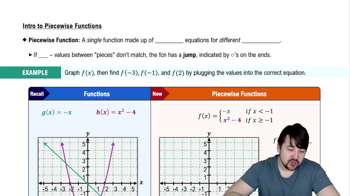
A piecewise function is defined by different expressions based on the input value. In this case, the function f(x) has two distinct formulas: one for x greater than or equal to 0 and another for x less than 0. Understanding how to evaluate and analyze these functions at specific points is crucial for determining properties like continuity and differentiability.
Video consigliato:
Percorso guidato
05:36
Piecewise Functions

Differentiability

A function is differentiable at a point if it has a defined derivative at that point, which means the function must be continuous and have a consistent slope from both sides. To check differentiability at x = 0, we need to ensure that the left-hand derivative (from x < 0) and the right-hand derivative (from x ≥ 0) are equal. If they differ, the function is not differentiable at that point.
Video consigliato:
Percorso guidato
05:53
Finding Differentials

Continuity

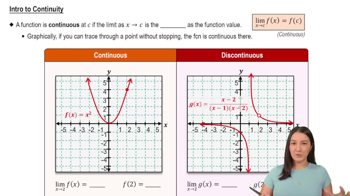
Continuity at a point means that the function's value at that point matches the limit of the function as it approaches that point from both sides. For f(x) to be differentiable at x = 0, it must first be continuous there. This involves checking that the values of the two pieces of the function agree at x = 0, ensuring no jumps or breaks in the graph.
Video consigliato:
05:34
Intro to Continuity
Pratica correlata
Domanda del libro di testo

In Exercises 41–44, determine whether the piecewise-defined function is differentiable at x = 0.


g(x) = { 2x − x³ − 1, x ≥ 0

x − (1 / (x + 1)), x < 0

306
views

Domanda del libro di testo

In Exercises 5–10, find an equation for the tangent line to the curve at the given point. Then sketch the curve and tangent line together.


y = (1 / x²), (−1, 1)

209
views
Domanda del libro di testo

Derivative Calculations


In Exercises 1–8, given y = f(u) and u = g(x), find dy/dx = f'(g(x)) g'(x).


y = cos u, u = −x/3

263
views
Domanda del libro di testo

Find the derivatives of the functions in Exercises 1–42.


𝔂 = (x + 1)² (x² + 2x)

203
views
Domanda del libro di testo

The best quantity to order One of the formulas for inventory management says that the average weekly cost of ordering, paying for, and holding merchandise is

A(q) = (km / q) + cm + (hq / 2),

where q is the quantity you order when things run low (shoes, TVs, brooms, or whatever the item might be); k is the cost of placing an order (the same, no matter how often you order); c is the cost of one item (a constant); m is the number of items sold each week (a constant); and h is the weekly holding cost per item (a constant that takes into account things such as space, utilities, insurance, and security).

Find dA/dq and d²A/dq².

155
views
Domanda del libro di testo

Slopes and Tangent Lines


In Exercises 1–4, use the grid and a straight edge to make a rough estimate of the slope of the curve (in y-units per x-unit) at the points P₁ and P₂.


256
views