

Ch. 3 - Derivatives
Hass - Thomas' Calculus 15th Edition
Hass15th EditionThomas' CalculusISBN: 9780137616077Non è quello che usi tu?Cambia libro di testo
Capitolo 3, Problema 3.4.6c

Motion Along a Coordinate Line


Exercises 1–6 give the positions s = f(t) of a body moving on a coordinate line, with s in meters and t in seconds.


c. When, if ever, during the interval does the body change direction?


s = 25/(t + 5), −4 ≤ t ≤ 0

Guida verificata passo dopo passo
1
First, understand that the body changes direction when its velocity changes sign. Velocity is the derivative of the position function with respect to time, v(t) = f'(t).
Calculate the derivative of the position function s = \(\frac{25}{t + 5}\). Use the quotient rule for derivatives, which states that if you have a function \(\frac{u}{v}\), its derivative is \(\frac{u'v - uv'}{v^2}\).
Apply the quotient rule: Let u = 25 and v = t + 5. Then, u' = 0 and v' = 1. Substitute these into the quotient rule formula to find v(t).
Simplify the expression obtained from the quotient rule to find the velocity function v(t). This will give you v(t) = \(\frac{-25}{(t + 5)^2}\).
Determine when the velocity changes sign by analyzing the expression \(\frac{-25}{(t + 5)^2}\). Since the numerator is negative and the denominator is always positive for the given interval, the velocity does not change sign, indicating the body does not change direction in the interval −4 ≤ t ≤ 0.

Risposta video verificata per un problema simile:

Questa soluzione video è stata consigliata dai nostri tutor come utile per risolvere questo problema.
Durata del video:
3m

Concetti chiave

Ecco i concetti essenziali che devi comprendere per rispondere correttamente alla domanda.

Derivative and Velocity

The derivative of a position function s = f(t) with respect to time t gives the velocity of the body. Velocity indicates the rate of change of position and its sign (positive or negative) shows the direction of motion. To determine when the body changes direction, we need to find when the velocity changes sign, which occurs when the derivative equals zero or is undefined.
Video consigliato:
Percorso guidato
06:29
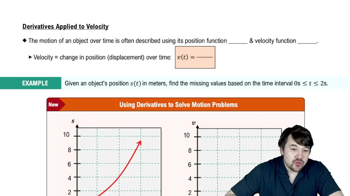
Derivatives Applied To Velocity

Critical Points

Critical points occur where the derivative of a function is zero or undefined. These points are essential in analyzing the behavior of the function, such as identifying potential changes in direction for motion problems. By evaluating the derivative of s = 25/(t + 5), we can find critical points within the interval −4 ≤ t ≤ 0 to determine when the body might change direction.
Video consigliato:
04:50
Critical Points

Interval Analysis

Interval analysis involves examining the behavior of a function over a specific range of values. For motion problems, this means checking the sign of the velocity before and after critical points within the given interval. By analyzing the intervals around critical points, we can confirm if and when the body changes direction by observing changes in the sign of the velocity.
Video consigliato:
02:59
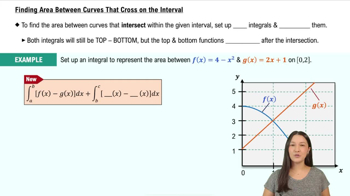
Finding Area Between Curves that Cross on the Interval
Pratica correlata
Domanda del libro di testo

Suppose that the functions f and g and their derivatives with respect to x have the following values at x = 0 and x = 1.


" style="max-width: 100%; white-space-collapse: preserve;" width="250">


Find the derivatives with respect to x of the following combinations at the given value of x.


c. f(x) / (g(x) + 1), x = 1

235
views
Domanda del libro di testo

Right circular cylinder The total surface area S of a right circular cylinder is related to the base radius r and height h by the equation S = 2πr² + 2πrh.


c. How is dS/dt related to dr/dt and dh/dt if neither r nor h is constant?

934
views
Domanda del libro di testo

Differentiability and Continuity on an Interval


Each figure in Exercises 45–50 shows the graph of a function over a closed interval D. At what domain points does the function appear to be


c. neither continuous nor differentiable?


Give reasons for your answers.


193
views
Domanda del libro di testo

Diagonals If x, y, and z are lengths of the edges of a rectangular box, then the common length of the box’s diagonals is s = √(x² + y² + z²).

c. How are dx/dt, dy/dt, and dz/dt related if s is constant?

194
views
Domanda del libro di testo

By computing the first few derivatives and looking for a pattern, find the following derivatives.


c. d⁷³/dx⁷³ (x sin x)

193
views
Domanda del libro di testo

Particle motion At time t, the position of a body moving along the s-axis is s = t³ − 6t² + 9t m.


c. Find the total distance traveled by the body from t = 0 to t = 2.

243
views