

Ch. 3 - Derivatives
Hass - Thomas' Calculus 15th Edition
Hass15th EditionThomas' CalculusISBN: 9780137616077Non è quello che usi tu?Cambia libro di testo
Capitolo 3, Problema 3.5.53c

By computing the first few derivatives and looking for a pattern, find the following derivatives.


c. d⁷³/dx⁷³ (x sin x)

Guida verificata passo dopo passo
1
First, identify the function for which you need to find the 73rd derivative: f(x) = x sin(x).
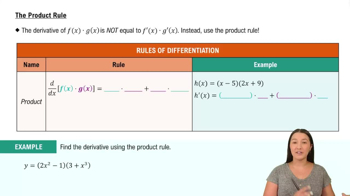
Compute the first derivative using the product rule: d/dx [x sin(x)] = x d/dx[sin(x)] + sin(x) d/dx[x].
The first derivative is: f'(x) = x cos(x) + sin(x).
Compute the second derivative by applying the product rule to each term in f'(x): f''(x) = d/dx[x cos(x)] + d/dx[sin(x)].
Continue finding higher-order derivatives and look for a pattern in the derivatives to generalize the 73rd derivative.

Risposta video verificata per un problema simile:

Questa soluzione video è stata consigliata dai nostri tutor come utile per risolvere questo problema.
Durata del video:
10m

Concetti chiave

Ecco i concetti essenziali che devi comprendere per rispondere correttamente alla domanda.

Product Rule

The product rule is a fundamental technique in calculus used to find the derivative of a product of two functions. If you have two differentiable functions, u(x) and v(x), the derivative of their product is given by (uv)' = u'v + uv'. This rule is essential when differentiating expressions like x sin(x), where both x and sin(x) are functions of x.
Video consigliato:
05:18
The Product Rule

Higher Order Derivatives

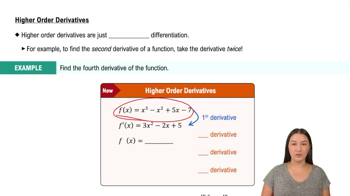
Higher order derivatives refer to the derivatives of a function taken multiple times. For example, the second derivative is the derivative of the derivative, and so on. In this problem, you are asked to find the 73rd derivative, which involves repeatedly applying differentiation rules and identifying any emerging patterns in the derivatives.
Video consigliato:
02:42
Higher Order Derivatives

Pattern Recognition in Derivatives

When computing higher order derivatives, recognizing patterns can simplify the process. For functions like x sin(x), derivatives often follow a cyclical pattern due to the periodic nature of trigonometric functions. Identifying these patterns allows for efficient computation of derivatives without performing each differentiation step manually.
Video consigliato:
Pratica correlata
Domanda del libro di testo

Motion Along a Coordinate Line


Exercises 1–6 give the positions s = f(t) of a body moving on a coordinate line, with s in meters and t in seconds.


c. When, if ever, during the interval does the body change direction?


s = 25/(t + 5), −4 ≤ t ≤ 0

209
views
Domanda del libro di testo

Analyzing Motion Using Graphs


[Technology Exercise] Exercises 31–34 give the position function s = f(t) of an object moving along the s-axis as a function of time t. Graph f together with the velocity function v(t) = ds/dt = f'(t) and the acceleration function a(t) = d²s/dt² = f''(t). Comment on the object’s behavior in relation to the signs and values of v and a. Include in your commentary such topics as the following:


d. When does it speed up and slow down?


s = t³ - 6t² + 7t, 0 ≤ t ≤ 4

217
views
Domanda del libro di testo

Suppose that the functions f and g and their derivatives with respect to x have the following values at x = 0 and x = 1.


" style="max-width: 100%; white-space-collapse: preserve;" width="250">


Find the derivatives with respect to x of the following combinations at the given value of x.


c. f(x) / (g(x) + 1), x = 1

235
views
Domanda del libro di testo

Differentiability and Continuity on an Interval


Each figure in Exercises 45–50 shows the graph of a function over a closed interval D. At what domain points does the function appear to be


c. neither continuous nor differentiable?


Give reasons for your answers.


193
views
Domanda del libro di testo

Right circular cylinder The total surface area S of a right circular cylinder is related to the base radius r and height h by the equation S = 2πr² + 2πrh.


d. How is dr/dt related to dh/dt if S is constant?

246
views
Domanda del libro di testo

Particle motion At time t, the position of a body moving along the s-axis is s = t³ − 6t² + 9t m.


c. Find the total distance traveled by the body from t = 0 to t = 2.

243
views