Ch. 3 - Derivatives
Hass - Thomas' Calculus 15th Edition
Hass15th EditionThomas' CalculusISBN: 9780137616077Non è quello che usi tu?Cambia libro di testo
Capitolo 3, Problema 3.3.32b

Recovering a function from its derivative


b. Repeat part (a), assuming that the graph starts at (−2, 0) instead of (−2, 3).

Guida verificata passo dopo passo
1
Step 1: Understand the problem. We need to find the original function given its derivative and a starting point on the graph. The starting point is (-2, 0).
Step 2: Recall that the process of recovering a function from its derivative involves integration. If the derivative of a function is given as f'(x), then the original function f(x) can be found by integrating f'(x).
Step 3: Set up the integral of the derivative function. If f'(x) is the derivative, then the integral ∫f'(x) dx will give us f(x) + C, where C is the constant of integration.
Step 4: Use the given point (-2, 0) to find the constant of integration C. Substitute x = -2 into the integrated function f(x) + C and set it equal to 0, since f(-2) = 0.
Step 5: Solve for C using the equation from Step 4. Once C is determined, write the final expression for the original function f(x) by substituting C back into the integrated function.

Risposta video verificata per un problema simile:

Questa soluzione video è stata consigliata dai nostri tutor come utile per risolvere questo problema.
Durata del video:
4m

Concetti chiave

Ecco i concetti essenziali che devi comprendere per rispondere correttamente alla domanda.

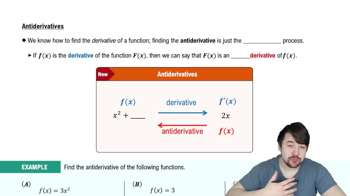
Antiderivative

An antiderivative of a function is another function whose derivative is the original function. To recover a function from its derivative, you find the antiderivative, which involves reversing the differentiation process. This is crucial for understanding how to reconstruct the original function from its rate of change.
Video consigliato:
Percorso guidato
05:50
Antiderivatives

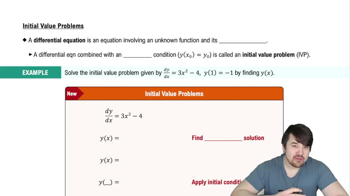
Initial Condition

An initial condition specifies the value of the function at a particular point, which is essential for determining the constant of integration when finding an antiderivative. In this problem, the initial condition is given by the point (−2, 0), which helps to uniquely define the recovered function.
Video consigliato:
Percorso guidato
05:03
Initial Value Problems

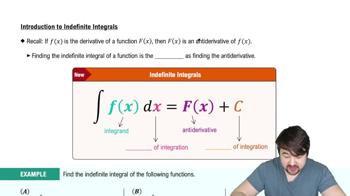
Constant of Integration

The constant of integration arises when computing the antiderivative of a function, representing an infinite family of solutions. It is determined using initial conditions, such as the starting point of the graph, to ensure the recovered function accurately reflects the original function's behavior.
Video consigliato:
Percorso guidato
05:04
Introduction to Indefinite Integrals
Pratica correlata
Domanda del libro di testo

Right circular cone The lateral surface area S of a right circular cone is related to the base radius r and height h by the equation

______

S = πr √ r² + h².


b. How is dS/dt related to dh/dt if r is constant?

270
views

Domanda del libro di testo

Analyzing Motion Using Graphs


[Technology Exercise] Exercises 31–34 give the position function s = f(t) of an object moving along the s-axis as a function of time t. Graph f together with the velocity function v(t) = ds/dt = f'(t) and the acceleration function a(t) = d²s/dt² = f''(t). Comment on the object’s behavior in relation to the signs and values of v and a. Include in your commentary such topics as the following:


b. When does it move to the left (down) or to the right (up)?


s = 200t - 16t², 0 ≤ t ≤ 12.5 (a heavy object fired straight up from Earth’s surface at 200 ft/sec)

189
views
Domanda del libro di testo

The Reciprocal Rule


b. Show that the Reciprocal Rule and the Derivative Product Rule together imply the Derivative Quotient Rule.

278
views
Domanda del libro di testo

Particle motion At time t ≥ 0, the velocity of a body moving along the horizontal s-axis is v = t² − 4t + 3.


b. When is the body moving forward? Backward?

232
views
Domanda del libro di testo

Suppose that functions ƒ(x) and g(x) and their first derivatives have the following values at x = 0 and x = 1.


x ƒ(x) g(x) ƒ'(x) g'(x)

0 1 1 -3 1/2

1 3 5 1/2 -4


Find the first derivatives of the following combinations at the given value of x.


b. ƒ(x)g²(x), x = 0

228
views
Domanda del libro di testo

Tolerance


b. About how accurately must the tank’s exterior diameter be measured to calculate the amount of paint it will take to paint the side of the tank to within 5% of the true amount?

187
views