b. Slopes on a tangent curve What is the smallest value the slope of the curve can ever have on the interval −2 < x < 2? Give reasons for your answer.
Ch. 3 - Derivatives
Capitolo 3, Problema 3.57b
Suppose that functions ƒ(x) and g(x) and their first derivatives have the following values at x = 0 and x = 1.
x ƒ(x) g(x) ƒ'(x) g'(x)
0 1 1 -3 1/2
1 3 5 1/2 -4
Find the first derivatives of the following combinations at the given value of x.
b. ƒ(x)g²(x), x = 0
Guida verificata passo dopo passo1
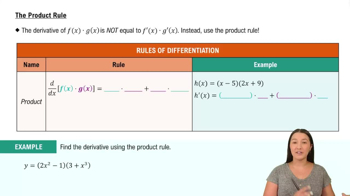
To find the derivative of the function ƒ(x)g²(x) at x = 0, we need to apply the product rule and the chain rule. The product rule states that the derivative of a product of two functions u(x) and v(x) is given by u'(x)v(x) + u(x)v'(x).
In this case, let u(x) = ƒ(x) and v(x) = g²(x). We need to find the derivative of v(x) using the chain rule. The chain rule states that the derivative of a composite function h(g(x)) is h'(g(x))g'(x).
Since v(x) = g²(x), we can express it as h(g(x)) where h(x) = x². The derivative h'(x) is 2x, so the derivative of v(x) = g²(x) is 2g(x)g'(x).
Now, apply the product rule: the derivative of ƒ(x)g²(x) is ƒ'(x)g²(x) + ƒ(x)(2g(x)g'(x)).
Substitute the given values at x = 0: ƒ'(0) = -3, g(0) = 1, g'(0) = 1/2, and ƒ(0) = 1. Calculate ƒ'(0)g²(0) + ƒ(0)(2g(0)g'(0)) using these values.

Risposta video verificata per un problema simile:
Questa soluzione video è stata consigliata dai nostri tutor come utile per risolvere questo problema.
Durata del video:
3mConcetti chiave
Ecco i concetti essenziali che devi comprendere per rispondere correttamente alla domanda.
Product Rule
The Product Rule is a fundamental principle in calculus used to differentiate products of two functions. It states that if you have two functions, ƒ(x) and g(x), the derivative of their product is given by ƒ'(x)g(x) + ƒ(x)g'(x). This rule is essential for finding the derivative of combinations of functions, such as ƒ(x)g²(x), as it allows us to apply the differentiation process systematically.
Video consigliato:
The Product Rule
Chain Rule
The Chain Rule is another critical differentiation technique used when dealing with composite functions. It states that if a function y is composed of another function u, then the derivative of y with respect to x is the derivative of y with respect to u multiplied by the derivative of u with respect to x. In the context of g²(x), the Chain Rule helps us differentiate the square of the function g(x) effectively.
Video consigliato:
Intro to the Chain Rule
Evaluating Derivatives at Specific Points
Evaluating derivatives at specific points involves substituting the given x-value into the derivative expression to find the slope of the function at that point. In this problem, we need to compute the derivatives of ƒ(x)g²(x) at x = 0, which requires using the values of ƒ(0), g(0), ƒ'(0), and g'(0) provided in the table. This step is crucial for obtaining the final numerical result.
Video consigliato:
Critical Points
Pratica correlata
Domanda del libro di testo
247
views
Domanda del libro di testo
The Reciprocal Rule
b. Show that the Reciprocal Rule and the Derivative Product Rule together imply the Derivative Quotient Rule.
278
views
Domanda del libro di testo
Particle motion At time t ≥ 0, the velocity of a body moving along the horizontal s-axis is v = t² − 4t + 3.
b. When is the body moving forward? Backward?
232
views
Domanda del libro di testo
Theory and Examples
In Exercises 51–54,
b. Graph y = f(x) and y = f'(x) side by side using separate sets of coordinate axes, and answer the following questions.
y = x⁴/4
160
views
Domanda del libro di testo
Common linear approximations at x = 0 Find the linearizations of the following functions at x = 0.
b. cos x
181
views
Domanda del libro di testo
Recovering a function from its derivative
b. Repeat part (a), assuming that the graph starts at (−2, 0) instead of (−2, 3).
280
views