


Ch. 3 - Derivatives
Hass - Thomas' Calculus 15th Edition
Hass15th EditionThomas' CalculusISBN: 9780137616077Non è quello che usi tu?Cambia libro di testo
Capitolo 3, Problema 25a

[Technology Exercise]


Draining a tank It takes 12 hours to drain a storage tank by opening the valve at the bottom. The depth y of fluid in the tank t hours after the valve is opened is given by the formula


y = 6(1 - t/12)² m.


a. Find the rate dy/dt (m/h) at which the tank is draining at time t.

Guida verificata passo dopo passo
1
Identify the given function for the depth of fluid in the tank: \( y = 6(1 - \frac{t}{12})^2 \). This function represents the depth of the fluid in meters as a function of time \( t \) in hours.
To find the rate at which the tank is draining, we need to compute the derivative of \( y \) with respect to \( t \), which is \( \frac{dy}{dt} \). This derivative will give us the rate of change of the fluid depth over time.
Apply the chain rule to differentiate \( y = 6(1 - \frac{t}{12})^2 \). The chain rule states that if you have a composite function \( f(g(t)) \), then \( \frac{d}{dt}[f(g(t))] = f'(g(t)) \cdot g'(t) \).
First, differentiate the outer function \( f(u) = 6u^2 \) with respect to \( u \), where \( u = 1 - \frac{t}{12} \). The derivative is \( f'(u) = 12u \).
Next, differentiate the inner function \( g(t) = 1 - \frac{t}{12} \) with respect to \( t \). The derivative is \( g'(t) = -\frac{1}{12} \). Combine these using the chain rule: \( \frac{dy}{dt} = 12(1 - \frac{t}{12}) \cdot (-\frac{1}{12}) \).

Risposta video verificata per un problema simile:

Questa soluzione video è stata consigliata dai nostri tutor come utile per risolvere questo problema.
Durata del video:
3m

Concetti chiave

Ecco i concetti essenziali che devi comprendere per rispondere correttamente alla domanda.

Derivative

The derivative of a function represents the rate at which the function's value changes with respect to a change in its input. In this context, dy/dt is the derivative of the depth y with respect to time t, indicating how quickly the fluid level in the tank is decreasing over time.
Video consigliato:

Chain Rule

The chain rule is a fundamental technique in calculus used to differentiate composite functions. It states that the derivative of a composite function is the derivative of the outer function evaluated at the inner function times the derivative of the inner function. This rule is essential for finding dy/dt when y is expressed as a function of t.
Video consigliato:
05:02
Intro to the Chain Rule

Quadratic Function

A quadratic function is a polynomial function of degree two, typically in the form ax² + bx + c. In this problem, y = 6(1 - t/12)² is a quadratic function of t. Understanding its structure helps in applying the chain rule and finding the derivative, as it involves recognizing the inner function (1 - t/12) and its square.
Video consigliato:
6:04
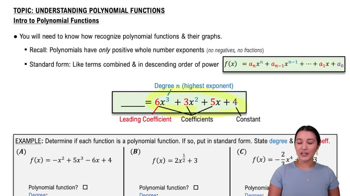
Introduction to Polynomial Functions
Pratica correlata
Domanda del libro di testo

The number of gallons of water in a tank t minutes after the tank has started to drain is Q(t) = 200(30 - t)². How fast is the water running out at the end of 10 min? What is the average rate at which the water flows out during the first 10 min?

261
views
Domanda del libro di testo

Economics


Marginal revenue

Suppose that the revenue from selling x washing machines is


r(x) = 20000(1 − 1/x) dollars.


c. Find the limit of r'(x) as x → ∞. How would you interpret this number?

192
views
Domanda del libro di testo

[Technology Exercise]


Draining a tank It takes 12 hours to drain a storage tank by opening the valve at the bottom. The depth y of fluid in the tank t hours after the valve is opened is given by the formula


y = 6(1 - t/12)² m.


b. When is the fluid level in the tank falling fastest? Slowest? What are the values of dy/dt at these times?

235
views
Domanda del libro di testo

Vehicular stopping distance Based on data from the U.S. Bureau of Public Roads, a model for the total stopping distance of a moving car in terms of its speed is s = 1.1v + 0.054v², where s is measured in ft and v in mph. The linear term 1.1v models the distance the car travels during the time the driver perceives a need to stop until the brakes are applied, and the quadratic term 0.054v² models the additional braking distance once they are applied. Find ds/dv at v = 35 and v = 70 mph, and interpret the meaning of the derivative.

208
views
Domanda del libro di testo

Using the Alternative Formula for Derivatives


Use the formula

f'(x) = lim (z → x) (f(z) − f(x)) / (z − x)

to find the derivative of the functions in Exercises 23–26.


f(x) = x² − 3x + 4

272
views
Domanda del libro di testo

Additional Applications


Bacterium population

When a bactericide was added to a nutrient broth in which bacteria were growing, the bacterium population continued to grow for a while, but then stopped growing and began to decline. The size of the population at time t (hours) was b = 10⁶ + 10⁴t − 10³t². Find the growth rates at


a. t = 0 hours.

b. t = 5 hours.

c. t = 10 hours.

217
views