
Ch. 4 - Applications of Derivatives
Hass - Thomas' Calculus 15th Edition
Hass15th EditionThomas' CalculusISBN: 9780137616077Non è quello che usi tu?Cambia libro di testo
Capitolo 4, Problema 4.4.117

117. Suppose that the second derivative of the function y = f(x) isy" =(x+1)(x-2).
For what x-values does the graph of f have an inflection point?

Guida verificata passo dopo passo
1
To find the x-values where the graph of f has an inflection point, we need to determine where the second derivative changes sign. An inflection point occurs where the concavity of the function changes.
Start by setting the second derivative equal to zero: y'' = (x+1)(x-2) = 0. Solve this equation to find the critical points.
Factor the equation: (x+1)(x-2) = 0. This gives us two solutions: x = -1 and x = 2.
To confirm these are inflection points, check the sign of the second derivative around these values. Choose test points in the intervals (-\(\text{∞}\), -1), (-1, 2), and (2, \(\text{∞}\)).
Evaluate the sign of y'' at these test points to determine if the sign changes. If the sign changes, then the corresponding x-value is an inflection point.

Risposta video verificata per un problema simile:

Questa soluzione video è stata consigliata dai nostri tutor come utile per risolvere questo problema.
Durata del video:
2m

Concetti chiave

Ecco i concetti essenziali che devi comprendere per rispondere correttamente alla domanda.

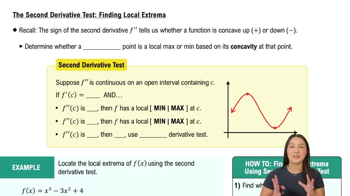
Second Derivative Test

The second derivative test is used to determine the concavity of a function and identify inflection points. An inflection point occurs where the second derivative changes sign, indicating a transition from concave up to concave down or vice versa. For the function y = f(x), the inflection points are found by setting the second derivative equal to zero and solving for x.
Video consigliato:
06:02
The Second Derivative Test: Finding Local Extrema

Factoring Quadratic Expressions

Factoring quadratic expressions involves rewriting them as a product of linear factors. In the given second derivative y'' = (x+1)(x-2), the expression is already factored, indicating potential x-values where the derivative equals zero. These values, x = -1 and x = 2, are critical for determining where the graph might have inflection points.
Video consigliato:
6:36
Simplifying Trig Expressions

Sign Change Analysis

Sign change analysis involves examining the intervals around the roots of the second derivative to determine where the sign changes. This helps confirm the presence of inflection points. For y'' = (x+1)(x-2), check the sign of y'' in intervals around x = -1 and x = 2 to ensure it changes, confirming these x-values as inflection points.
Video consigliato:
Percorso guidato
06:35
Changing Geometries