
Ch. 4 - Applications of Derivatives
Hass - Thomas' Calculus 15th Edition
Hass15th EditionThomas' CalculusISBN: 9780137616077Non è quello che usi tu?Cambia libro di testo
Capitolo 4, Problema 4.7.81

Initial Value Problems


Solve the initial value problems in Exercises 71–90.


dv/dt = (1/2)sec t tan t, v(0) = 1

Guida verificata passo dopo passo
1
Identify the given differential equation and initial condition: \(\frac{dv}{dt} = \frac{1}{2} \sec t \tan t\), with \(v(0) = 1\).
Recognize that this is a separable differential equation where the right side is a function of \(t\) only, so you can integrate both sides with respect to \(t\) to find \(v(t)\).
Set up the integral: \(v(t) = \int \frac{1}{2} \sec t \tan t \, dt + C\), where \(C\) is the constant of integration.
Recall the integral formula: \(\int \sec t \tan t \, dt = \sec t + C\). Use this to integrate the right side.
Apply the initial condition \(v(0) = 1\) to solve for the constant \(C\) by substituting \(t=0\) and \(v=1\) into the expression for \(v(t)\).

Risposta video verificata per un problema simile:

Questa soluzione video è stata consigliata dai nostri tutor come utile per risolvere questo problema.
Durata del video:
2m

Concetti chiave

Ecco i concetti essenziali che devi comprendere per rispondere correttamente alla domanda.

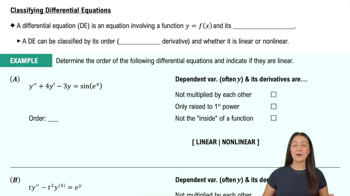
Differential Equations

A differential equation relates a function with its derivatives. Solving it involves finding the original function that satisfies the given relationship between the function and its rate of change.
Video consigliato:
07:39
Classifying Differential Equations

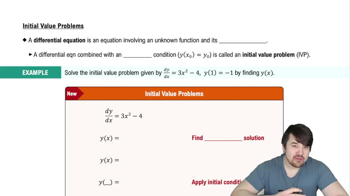
Initial Value Problems (IVP)

An initial value problem specifies the value of the unknown function at a particular point, allowing for a unique solution to the differential equation by applying this initial condition.
Video consigliato:
Percorso guidato
05:03
Initial Value Problems

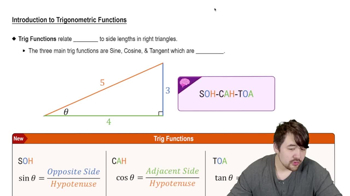
Integration of Trigonometric Functions

Solving the differential equation requires integrating trigonometric expressions like sec t and tan t. Knowing standard integrals and techniques for these functions is essential to find the explicit solution.
Video consigliato:
Percorso guidato
6:04
Introduction to Trigonometric Functions
Pratica correlata
Domanda del libro di testo

Finding Indefinite Integrals


In Exercises 17–56, find the most general antiderivative or indefinite integral. You may need to try a solution and then adjust your guess. Check your answers by differentiation.


∫(sin2x − csc²x)dx

27
views
Domanda del libro di testo

Absolute Extrema on Finite Closed Intervals


In Exercises 21–36, find the absolute maximum and minimum values of each function on the given interval. Then graph the function. Identify the points on the graph where the absolute extrema occur, and include their coordinates.


f(x) = (2/3)x − 5, −2 ≤ x ≤ 3

210
views
Domanda del libro di testo

117. Suppose that the second derivative of the function y = f(x) isy" =(x+1)(x-2).

For what x-values does the graph of f have an inflection point?

222
views
Domanda del libro di testo

Identifying Extrema


In Exercises 19–40:


a. Find the open intervals on which the function is increasing and those on which it is decreasing.


b. Identify the function’s local extreme values, if any, saying where they occur.


f(x) = x³ / (3x² + 1)

159
views
Domanda del libro di testo

Checking the Mean Value Theorem


Find the value or values of c that satisfy the equation (f(b) − f(a)) / (b − a) = f′(c) in the conclusion of the Mean Value Theorem for the functions and intervals in Exercises 1–6.


g(x) = {x³, −2 ≤ x ≤ 0

x², 0 < x ≤ 2

245
views
Domanda del libro di testo

Finding Critical Points


In Exercises 41–50, determine all critical points and all domain endpoints for each function.


y = x² − 32√x

200
views