
Ch. 4 - Applications of Derivatives
Hass - Thomas' Calculus 15th Edition
Hass15th EditionThomas' CalculusISBN: 9780137616077Non è quello che usi tu?Cambia libro di testo
Capitolo 4, Problema 4.5.37

37. What value of a makes f(x) = x^2 +(a/x) have
a. a local minimum at x = 2?
b. a point of inflection at x = 1?

Guida verificata passo dopo passo
1
To find the value of 'a' that makes f(x) = x^2 + (a/x) have a local minimum at x = 2, first find the first derivative f'(x) and set it equal to zero to find critical points. The derivative is f'(x) = 2x - a/x^2.
Substitute x = 2 into the derivative equation: 2(2) - a/(2^2) = 0. Solve this equation for 'a' to find the value that makes x = 2 a critical point.
To ensure that x = 2 is a local minimum, check the second derivative f''(x) = 2 + 2a/x^3. Substitute x = 2 and the value of 'a' found in the previous step into f''(x) to verify that f''(2) > 0.
For the point of inflection at x = 1, find the second derivative f''(x) = 2 + 2a/x^3 and set it equal to zero. Substitute x = 1 into the equation: 2 + 2a/(1^3) = 0. Solve this equation for 'a' to find the value that makes x = 1 a point of inflection.
Verify that the sign of f''(x) changes around x = 1 by checking the values of f''(x) just before and after x = 1 with the found value of 'a'. This confirms the point of inflection.

Risposta video verificata per un problema simile:

Questa soluzione video è stata consigliata dai nostri tutor come utile per risolvere questo problema.
Durata del video:
8m

Concetti chiave

Ecco i concetti essenziali che devi comprendere per rispondere correttamente alla domanda.

Local Minimum

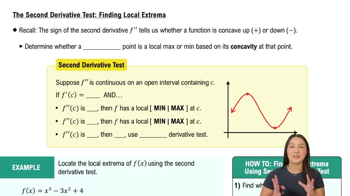
A local minimum of a function occurs at a point where the function value is lower than at nearby points. To find a local minimum, we use the first derivative test: set the derivative equal to zero to find critical points, and then use the second derivative to determine if the point is a minimum (second derivative > 0) or maximum (second derivative < 0).
Video consigliato:
06:02
The Second Derivative Test: Finding Local Extrema

Point of Inflection

A point of inflection is where the function changes concavity, from concave up to concave down or vice versa. It is identified by setting the second derivative equal to zero and confirming a change in sign around the point. This indicates a transition in the curvature of the graph, but not necessarily a local extremum.
Video consigliato:
04:50
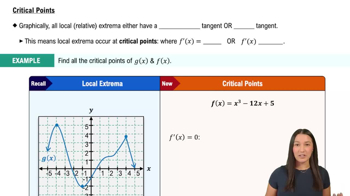
Critical Points

Derivative Calculation

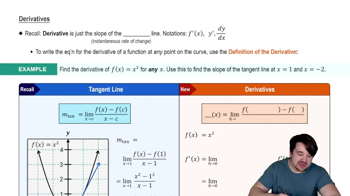
Calculating derivatives is essential for analyzing the behavior of functions. The first derivative, f'(x), provides information on the slope and critical points, while the second derivative, f''(x), helps determine concavity and points of inflection. For f(x) = x^2 + (a/x), apply differentiation rules to find these derivatives and solve for the conditions given in the problem.
Video consigliato:
Pratica correlata
Domanda del libro di testo

The intensity of illumination at any point from a light source is proportional to the square of the reciprocal of the distance between the point and the light source. Two lights, one having an intensity eight times that of the other, are 6 m apart. How far from the stronger light is the total illumination least?

250
views
Domanda del libro di testo

Identifying Extrema


In Exercises 19–40:


a. Find the open intervals on which the function is increasing and those on which it is decreasing.


b. Identify the function’s local extreme values, if any, saying where they occur.


f(x) = x¹ᐟ³(x + 8)

183
views
Domanda del libro di testo

In Exercises 1–10, find the extreme values (absolute and local) of the function over its natural domain, and where they occur.

__________

y = √ 3 + 2𝓍 ―𝓍²

226
views
Domanda del libro di testo

Initial Value Problems


Solve the initial value problems in Exercises 71–90.


d²y/dx² = 2 − 6x; y′(0) = 4, y(0) = 1

23
views
Domanda del libro di testo

Finding Indefinite Integrals


In Exercises 17–56, find the most general antiderivative or indefinite integral. You may need to try a solution and then adjust your guess. Check your answers by differentiation.


∫(t√t + √t) / t² dt

30
views
Domanda del libro di testo

Finding Indefinite Integrals


In Exercises 17–56, find the most general antiderivative or indefinite integral. You may need to try a solution and then adjust your guess. Check your answers by differentiation.


∫(1 + cos 4t)/2 dt

21
views