Ch. 4 - Applications of Derivatives
Hass - Thomas' Calculus 15th Edition
Hass15th EditionThomas' CalculusISBN: 9780137616077Non è quello che usi tu?Cambia libro di testo
Capitolo 4, Problema 4.2.12

Checking the Mean Value Theorem


Which of the functions in Exercises 7–12 satisfy the hypotheses of the Mean Value Theorem on the given interval, and which do not? Give reasons for your answers.


f(x) = {2x − 3, 0 ≤ x ≤ 2
6x − x² − 7, 2 < x ≤ 3

Guida verificata passo dopo passo
1
Step 1: Understand the Mean Value Theorem (MVT). The MVT states that if a function f is continuous on the closed interval [a, b] and differentiable on the open interval (a, b), then there exists at least one c in (a, b) such that f'(c) = (f(b) - f(a)) / (b - a).
Step 2: Check continuity of f(x) on the given intervals. For the piecewise function f(x), check if it is continuous at the point where the pieces meet, which is x = 2. Evaluate the left-hand limit and the right-hand limit at x = 2 to ensure they are equal.
Step 3: Check differentiability of f(x) on the open intervals. For each piece of the function, determine if the function is differentiable. For the first piece, f(x) = 2x - 3, check differentiability on (0, 2]. For the second piece, f(x) = 6x - x² - 7, check differentiability on (2, 3).
Step 4: Verify the differentiability at x = 2. Since the function is piecewise, ensure that the derivative from the left and the derivative from the right at x = 2 are equal. Calculate the derivatives of each piece and compare them at x = 2.
Step 5: Conclude whether the function satisfies the hypotheses of the MVT. If the function is both continuous on [0, 3] and differentiable on (0, 3), then it satisfies the MVT. Otherwise, identify which condition fails and explain why the MVT does not apply.

Risposta video verificata per un problema simile:

Questa soluzione video è stata consigliata dai nostri tutor come utile per risolvere questo problema.
Durata del video:
3m

Concetti chiave

Ecco i concetti essenziali che devi comprendere per rispondere correttamente alla domanda.

Mean Value Theorem

The Mean Value Theorem (MVT) states that for a function f that is continuous on a closed interval [a, b] and differentiable on the open interval (a, b), there exists at least one point c in (a, b) such that f'(c) equals the average rate of change over [a, b]. This theorem is crucial for understanding how the function behaves between two points.
Video consigliato:
Percorso guidato
06:11
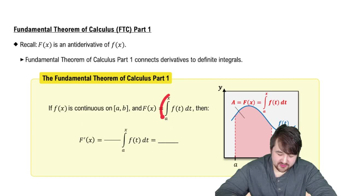
Fundamental Theorem of Calculus Part 1

Continuity

Continuity of a function on a closed interval [a, b] means that the function has no breaks, jumps, or holes in that interval. For the Mean Value Theorem to apply, the function must be continuous on the entire interval, ensuring that it can be smoothly traversed from one endpoint to the other without interruption.
Video consigliato:
05:34
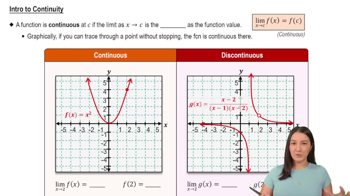
Intro to Continuity

Differentiability

Differentiability refers to the existence of a derivative at each point in an open interval (a, b). A function is differentiable if it has a defined tangent at every point in the interval, meaning it is smooth without any sharp corners or cusps. Differentiability is a necessary condition for applying the Mean Value Theorem.
Video consigliato:
Percorso guidato
05:53
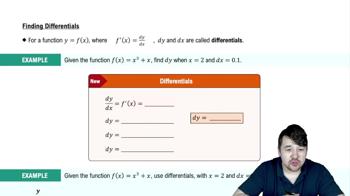
Finding Differentials