Ch. 4 - Applications of Derivatives
Hass - Thomas' Calculus 15th Edition
Hass15th EditionThomas' CalculusISBN: 9780137616077Non è quello che usi tu?Cambia libro di testo
Capitolo 4, Problema 4.1.48

Finding Critical Points


In Exercises 41–50, determine all critical points and all domain endpoints for each function.


g(x) = √(2x − x²)

Guida verificata passo dopo passo
1
First, identify the domain of the function g(x) = √(2x − x²). The expression inside the square root, 2x − x², must be greater than or equal to zero. Solve the inequality 2x − x² ≥ 0 to find the domain.
Rewrite the inequality 2x − x² ≥ 0 as x(2 − x) ≥ 0. This is a quadratic inequality, and we can solve it by finding the roots of the equation x(2 − x) = 0, which are x = 0 and x = 2.
Determine the intervals where the inequality holds by testing values in the intervals (−∞, 0), (0, 2), and (2, ∞). The inequality x(2 − x) ≥ 0 is satisfied in the interval [0, 2]. Thus, the domain of g(x) is [0, 2].
Find the critical points by taking the derivative of g(x). First, express g(x) in a form suitable for differentiation: g(x) = (2x − x²)^(1/2). Use the chain rule to differentiate: g'(x) = (1/2)(2x − x²)^(-1/2) * (2 - 2x).
Set the derivative g'(x) equal to zero to find critical points: (1/2)(2x − x²)^(-1/2) * (2 - 2x) = 0. Solve 2 - 2x = 0 to find x = 1. Check if x = 1 is within the domain [0, 2]. Since it is, x = 1 is a critical point. Also, consider the endpoints of the domain, x = 0 and x = 2, as potential critical points.

Risposta video verificata per un problema simile:

Questa soluzione video è stata consigliata dai nostri tutor come utile per risolvere questo problema.
Durata del video:
4m

Concetti chiave

Ecco i concetti essenziali che devi comprendere per rispondere correttamente alla domanda.

Critical Points

Critical points of a function occur where its derivative is zero or undefined. These points are important because they can indicate local maxima, minima, or points of inflection. To find them, take the derivative of the function and solve for the values of x where the derivative equals zero or does not exist.
Video consigliato:
04:50
Critical Points

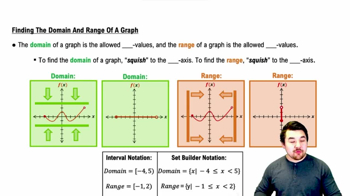
Domain of a Function

The domain of a function is the set of all possible input values (x-values) for which the function is defined. For the function g(x) = √(2x − x²), the expression inside the square root must be non-negative, as square roots of negative numbers are not real. Solving 2x − x² ≥ 0 will give the domain of the function.
Video consigliato:
Percorso guidato
5:10
Finding the Domain and Range of a Graph

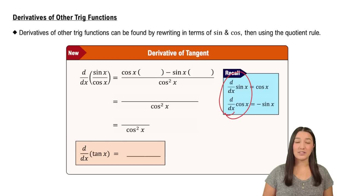
Derivative of a Function

The derivative of a function represents the rate of change of the function with respect to its variable. For g(x) = √(2x − x²), use the chain rule to differentiate. The derivative helps identify critical points and analyze the behavior of the function, such as increasing or decreasing intervals.
Video consigliato:
06:30
Derivatives of Other Trig Functions
Pratica correlata
Domanda del libro di testo

Root Finding

2. Use Newton's method to estimate the one real solution of x^3 +3x + 1 = 0. Start with x_0 = 0 and then find x_2.

240
views

Domanda del libro di testo

Checking the Mean Value Theorem


Which of the functions in Exercises 7–12 satisfy the hypotheses of the Mean Value Theorem on the given interval, and which do not? Give reasons for your answers.


f(x) = {2x − 3, 0 ≤ x ≤ 2

6x − x² − 7, 2 < x ≤ 3

205
views
Domanda del libro di testo

Finding Indefinite Integrals


In Exercises 17–56, find the most general antiderivative or indefinite integral. You may need to try a solution and then adjust your guess. Check your answers by differentiation.


∫(x + 1) dx

29
views
Domanda del libro di testo

Finding Indefinite Integrals


In Exercises 17–56, find the most general antiderivative or indefinite integral. You may need to try a solution and then adjust your guess. Check your answers by differentiation.


∫7sin(θ/3) dθ

29
views
Domanda del libro di testo

Finding Extrema from Graphs


In Exercises 15–20, sketch the graph of each function and determine whether the function has any absolute extreme values on its domain. Explain how your answer is consistent with Theorem 1.


f(x) = |x|, −1 < x < 2

218
views
Domanda del libro di testo

Finding Indefinite Integrals


In Exercises 17–56, find the most general antiderivative or indefinite integral. You may need to try a solution and then adjust your guess. Check your answers by differentiation.


∫(2x³ − 5x + 7) dx

16
views