Ch. 4 - Applications of Derivatives
Hass - Thomas' Calculus 15th Edition
Hass15th EditionThomas' CalculusISBN: 9780137616077Non è quello che usi tu?Cambia libro di testo
Capitolo 4, Problema 4.4.85

Each of Exercises 67–88 gives the first derivative of a continuous function y=f(x). Find y'' and then use Steps 2–4 of the graphing procedure described in this section to sketch the general shape of the graph of f.
85. y' = x^(-2/3) (x - 1)

Guida verificata passo dopo passo
1
Step 1: Compute the second derivative y'' by applying the product rule to y' = x^(-2/3) * (x - 1). Recall the product rule: (uv)' = u'v + uv'. Here, u = x^(-2/3) and v = (x - 1). Differentiate each term separately.
Step 2: For u = x^(-2/3), compute u' using the power rule: d/dx[x^n] = n*x^(n-1). This gives u' = (-2/3)*x^(-5/3). For v = (x - 1), compute v' as the derivative of (x - 1), which is simply 1.
Step 3: Substitute u, u', v, and v' into the product rule formula: y'' = u'v + uv'. This results in y'' = [(-2/3)*x^(-5/3)*(x - 1)] + [x^(-2/3)*1]. Simplify the expression to combine like terms.
Step 4: Analyze the critical points and inflection points by setting y'' = 0 and solving for x. These points will help determine the concavity and general shape of the graph of f(x). Additionally, consider the behavior of y'' as x approaches 0 and infinity to understand the graph's asymptotic behavior.
Step 5: Use the information from y'' and y' to sketch the general shape of the graph of f(x). Identify intervals where the graph is concave up or concave down, and mark any inflection points. Combine this with the behavior of y' to determine increasing or decreasing intervals.

Risposta video verificata per un problema simile:

Questa soluzione video è stata consigliata dai nostri tutor come utile per risolvere questo problema.
Durata del video:
16m

Concetti chiave

Ecco i concetti essenziali che devi comprendere per rispondere correttamente alla domanda.

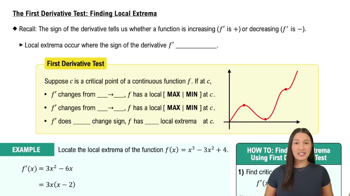
First Derivative

The first derivative of a function, denoted as y' or f'(x), represents the rate of change of the function with respect to its variable. It provides information about the slope of the tangent line to the graph of the function at any given point. Understanding the first derivative is crucial for determining critical points, where the function may have local maxima or minima.
Video consigliato:
07:09
The First Derivative Test: Finding Local Extrema

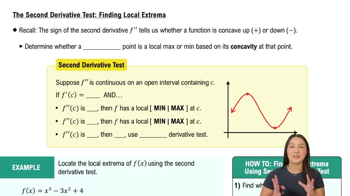
Second Derivative

The second derivative, denoted as y'' or f''(x), is the derivative of the first derivative. It indicates the rate of change of the slope of the function, providing insights into the concavity of the graph. A positive second derivative suggests the graph is concave up, while a negative second derivative indicates concave down, which is essential for sketching the function's general shape.
Video consigliato:
06:02
The Second Derivative Test: Finding Local Extrema

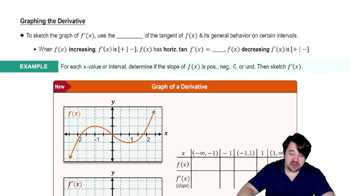
Graphing Procedure

The graphing procedure involves analyzing the first and second derivatives to sketch the function's graph. Steps typically include identifying critical points, determining intervals of increase or decrease, and assessing concavity. This systematic approach helps in visualizing the behavior of the function, including where it may have peaks, valleys, or inflection points.
Video consigliato:
Percorso guidato
06:15
Graphing The Derivative