
Ch. 4 - Applications of Derivatives
Hass - Thomas' Calculus 15th Edition
Hass15th EditionThomas' CalculusISBN: 9780137616077Non è quello che usi tu?Cambia libro di testo
Capitolo 4, Problema 4.1.13

Finding Extrema from Graphs


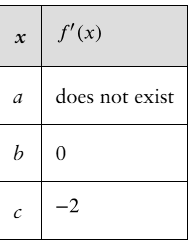
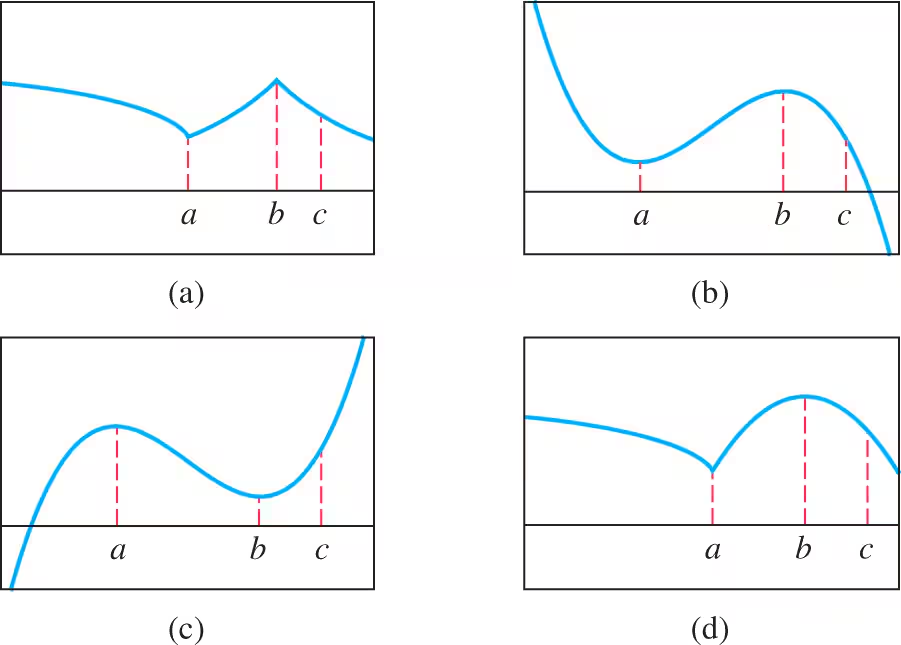
In Exercises 11–14, match the table with a graph.


Guida verificata passo dopo passo
1
Step 1: Analyze the table provided. It indicates the behavior of the derivative f'(x) at specific points: at x = a, f'(x) does not exist; at x = b, f'(x) = 0; and at x = c, f'(x) = -2.
Step 2: Understand the implications of the derivative values: - 'f'(x) does not exist' at x = a suggests a sharp corner or cusp in the graph at x = a. - 'f'(x) = 0' at x = b indicates a horizontal tangent line, which is typically a local maximum or minimum. - 'f'(x) = -2' at x = c implies the slope of the tangent line is negative, meaning the graph is decreasing at x = c.
Step 3: Examine the graphs provided (a, b, c, d) and identify the one that matches the behavior described in the table. Look for: - A sharp corner or cusp at x = a. - A horizontal tangent line at x = b. - A decreasing slope at x = c.
Step 4: Compare each graph systematically: - Graph (a): Sharp corner at x = a, horizontal tangent at x = b, decreasing slope at x = c. - Graph (b): Smooth curve at x = a, horizontal tangent at x = b, decreasing slope at x = c. - Graph (c): Smooth curve at x = a, horizontal tangent at x = b, increasing slope at x = c. - Graph (d): Sharp corner at x = a, horizontal tangent at x = b, decreasing slope at x = c.
Step 5: Based on the analysis, select the graph that matches all the conditions described in the table. The correct graph is the one with a sharp corner at x = a, a horizontal tangent at x = b, and a decreasing slope at x = c.

Risposta video verificata per un problema simile:

Questa soluzione video è stata consigliata dai nostri tutor come utile per risolvere questo problema.
Durata del video:
4m

Concetti chiave

Ecco i concetti essenziali che devi comprendere per rispondere correttamente alla domanda.

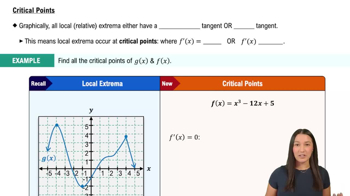
Critical Points

Critical points occur where the derivative of a function is either zero or undefined. These points are essential for finding local extrema, as they indicate where the function's slope changes, potentially leading to local maxima or minima. In the given table, point 'b' is a critical point since the derivative is zero, while point 'a' is critical because the derivative does not exist.
Video consigliato:
04:50
Critical Points

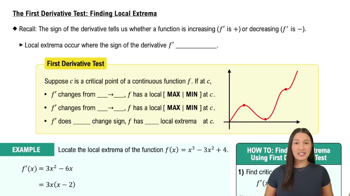
First Derivative Test

The First Derivative Test is a method used to determine whether a critical point is a local maximum, local minimum, or neither. By analyzing the sign of the derivative before and after the critical point, one can infer the behavior of the function. For instance, if the derivative changes from positive to negative at a critical point, it indicates a local maximum.
Video consigliato:
07:09
The First Derivative Test: Finding Local Extrema

Existence of Derivatives

The existence of a derivative at a point is crucial for determining the behavior of a function at that point. If the derivative does not exist, as in point 'a', it may indicate a cusp, corner, or vertical tangent, which can affect the function's continuity and extrema. Understanding where derivatives exist or do not exist helps in analyzing the overall shape and critical features of the graph.
Video consigliato:
03:07
Cases Where Limits Do Not Exist