Ch. 4 - Applications of Derivatives
Hass - Thomas' Calculus 15th Edition
Hass15th EditionThomas' CalculusISBN: 9780137616077Non è quello che usi tu?Cambia libro di testo
Capitolo 4, Problema 4.4.71

Each of Exercises 67–88 gives the first derivative of a continuous function y=f(x). Find y'' and then use Steps 2–4 of the graphing procedure described in this section to sketch the general shape of the graph of f.
71. y' = x(x² - 12)

Guida verificata passo dopo passo
1
First, find the second derivative y'' by differentiating y' = x(x² - 12). Use the product rule for differentiation, which states that if you have a function u(x)v(x), its derivative is u'(x)v(x) + u(x)v'(x). Here, let u(x) = x and v(x) = x² - 12.
Differentiate u(x) = x to get u'(x) = 1. Differentiate v(x) = x² - 12 to get v'(x) = 2x.
Apply the product rule: y'' = u'(x)v(x) + u(x)v'(x) = 1(x² - 12) + x(2x). Simplify this expression to find y''.
Now, analyze the critical points and concavity using y'' to understand the general shape of the graph of f(x). Critical points occur where y'' = 0 or is undefined. Determine these points and test intervals around them to see if y'' is positive (indicating concave up) or negative (indicating concave down).
Use the information from the second derivative test to sketch the general shape of the graph of f(x). Consider the behavior at critical points and the concavity to draw a rough sketch of the graph, showing where it is increasing, decreasing, concave up, and concave down.

Risposta video verificata per un problema simile:

Questa soluzione video è stata consigliata dai nostri tutor come utile per risolvere questo problema.
Durata del video:
9m

Concetti chiave

Ecco i concetti essenziali che devi comprendere per rispondere correttamente alla domanda.

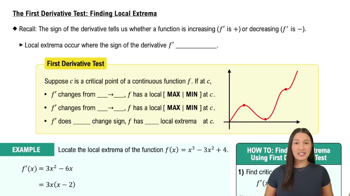
First Derivative

The first derivative of a function, denoted as y' or f'(x), represents the rate of change of the function with respect to x. It provides information about the slope of the tangent line to the graph of the function at any given point. Analyzing the first derivative helps identify critical points, where the function may have local maxima, minima, or points of inflection.
Video consigliato:
07:09
The First Derivative Test: Finding Local Extrema

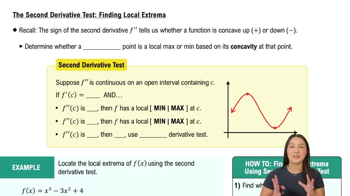
Second Derivative

The second derivative, denoted as y'' or f''(x), is the derivative of the first derivative. It indicates the rate of change of the slope of the function, providing insights into the concavity of the graph. If y'' is positive, the graph is concave up, suggesting a local minimum; if y'' is negative, the graph is concave down, indicating a local maximum.
Video consigliato:
06:02
The Second Derivative Test: Finding Local Extrema

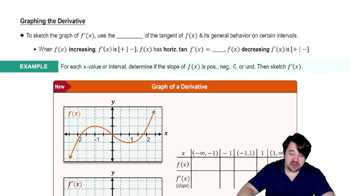
Graphing Procedure

The graphing procedure involves several steps to sketch the function based on its derivatives. Steps typically include finding critical points from the first derivative, determining concavity and inflection points from the second derivative, and analyzing the behavior of the function at these points. This systematic approach helps create an accurate representation of the function's overall shape.
Video consigliato:
Percorso guidato
06:15
Graphing The Derivative