
Ch. 4 - Applications of Derivatives
Hass - Thomas' Calculus 15th Edition
Hass15th EditionThomas' CalculusISBN: 9780137616077Non è quello che usi tu?Cambia libro di testo
Capitolo 4, Problema 4.1.54

Theory and Examples


In Exercises 53 and 54, show that the function has neither an absolute minimum nor an absolute maximum on its natural domain.


y = 3x + tan x

Guida verificata passo dopo passo
1
Identify the natural domain of the function y = 3x + tan(x). The function tan(x) is undefined at odd multiples of π/2, so the natural domain is all real numbers except x = (2n+1)π/2, where n is an integer.
Consider the behavior of the function as x approaches the points where tan(x) is undefined. As x approaches (2n+1)π/2 from the left, tan(x) approaches negative infinity, and from the right, tan(x) approaches positive infinity. This indicates that the function y = 3x + tan(x) has vertical asymptotes at these points.
Analyze the behavior of the function as x approaches positive and negative infinity. As x approaches positive or negative infinity, the linear term 3x dominates, causing the function to increase or decrease without bound.
Since the function has vertical asymptotes and increases or decreases without bound as x approaches infinity or negative infinity, it does not attain a highest or lowest value on its natural domain.
Conclude that the function y = 3x + tan(x) has neither an absolute minimum nor an absolute maximum on its natural domain due to the presence of vertical asymptotes and unbounded behavior at infinity.

Risposta video verificata per un problema simile:

Questa soluzione video è stata consigliata dai nostri tutor come utile per risolvere questo problema.
Durata del video:
2m

Concetti chiave

Ecco i concetti essenziali che devi comprendere per rispondere correttamente alla domanda.

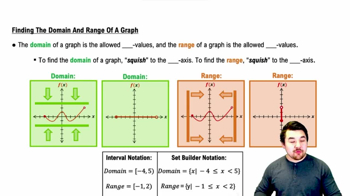
Natural Domain

The natural domain of a function is the set of all possible input values (x-values) for which the function is defined. For the function y = 3x + tan x, the natural domain excludes values where tan x is undefined, such as x = π/2 + kπ, where k is an integer. Understanding the domain is crucial for analyzing the behavior of the function across its entire range.
Video consigliato:
Percorso guidato
5:10
Finding the Domain and Range of a Graph

Absolute Minimum and Maximum

An absolute minimum or maximum refers to the lowest or highest value a function can attain on a given interval or domain. For y = 3x + tan x, determining the existence of absolute extrema involves analyzing the function's behavior and limits, especially considering the periodic nature and asymptotes of the tangent function, which can lead to unbounded behavior.
Video consigliato:
03:22
Finding Extrema Graphically Example 4

Behavior of Trigonometric Functions

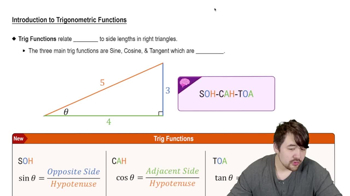
Trigonometric functions like tan x have unique properties, such as periodicity and asymptotes, which affect their graphs and values. The tangent function has vertical asymptotes at odd multiples of π/2, causing it to approach infinity. This behavior is key to understanding why y = 3x + tan x may not have absolute extrema, as the function can increase or decrease without bound near these asymptotes.
Video consigliato:
Percorso guidato
6:04
Introduction to Trigonometric Functions