Ch. 4 - Applications of Derivatives
Hass - Thomas' Calculus 15th Edition
Hass15th EditionThomas' CalculusISBN: 9780137616077Non è quello che usi tu?Cambia libro di testo
Capitolo 4, Problema 4.1.17

Finding Extrema from Graphs


In Exercises 15–20, sketch the graph of each function and determine whether the function has any absolute extreme values on its domain. Explain how your answer is consistent with Theorem 1.


g(x) = {−x, 0 ≤ x < 1
x − 1, 1 ≤ x ≤ 2

Guida verificata passo dopo passo
1
Step 1: Begin by understanding the function g(x) which is piecewise defined. The function is given as g(x) = -x for 0 ≤ x < 1 and g(x) = x - 1 for 1 ≤ x ≤ 2. This means the function has two different expressions depending on the interval of x.
Step 2: Sketch the graph of the function g(x). For the interval 0 ≤ x < 1, plot the line g(x) = -x, which is a straight line with a negative slope passing through the origin. For the interval 1 ≤ x ≤ 2, plot the line g(x) = x - 1, which is a straight line with a positive slope starting at the point (1, 0).
Step 3: Identify the endpoints and any points of interest. The function is defined on the interval [0, 2]. Check the values of g(x) at the endpoints: g(0) = 0 and g(2) = 1. Also, check the value at x = 1, where the function transitions from one piece to another: g(1) = 0.
Step 4: Determine the absolute extrema by comparing the values of g(x) at the endpoints and any critical points. Since g(0) = 0, g(1) = 0, and g(2) = 1, the absolute minimum value is 0, occurring at both x = 0 and x = 1. The absolute maximum value is 1, occurring at x = 2.
Step 5: Explain how the answer is consistent with Theorem 1, which states that if a function is continuous on a closed interval, it must have both a maximum and minimum value on that interval. Although g(x) is not continuous at x = 1, it is continuous on the intervals [0, 1) and [1, 2], allowing us to find the extrema within the domain.

Risposta video verificata per un problema simile:

Questa soluzione video è stata consigliata dai nostri tutor come utile per risolvere questo problema.
Durata del video:
5m

Concetti chiave

Ecco i concetti essenziali che devi comprendere per rispondere correttamente alla domanda.

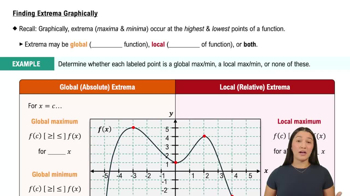
Absolute Extrema

Absolute extrema refer to the highest or lowest points on a function's graph over a given domain. An absolute maximum is the highest point, while an absolute minimum is the lowest. To find these, one must evaluate the function at critical points and endpoints within the domain, ensuring the function is continuous over the interval.
Video consigliato:
05:58
Finding Extrema Graphically

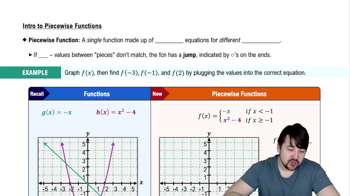
Piecewise Functions

Piecewise functions are defined by different expressions over different intervals of the domain. Understanding how to sketch and analyze these functions involves evaluating each piece separately and considering the behavior at the boundaries where the pieces meet. This is crucial for determining continuity and extrema within the function's domain.
Video consigliato:
Percorso guidato
05:36
Piecewise Functions

Theorem 1 (Extreme Value Theorem)

The Extreme Value Theorem states that if a function is continuous over a closed interval, it must have both an absolute maximum and minimum within that interval. This theorem helps in identifying extrema by ensuring that continuous functions on closed intervals will have extreme values, guiding the analysis of piecewise functions and their domains.
Video consigliato:
Percorso guidato
06:11
Fundamental Theorem of Calculus Part 1