Ch. 4 - Applications of Derivatives
Hass - Thomas' Calculus 15th Edition
Hass15th EditionThomas' CalculusISBN: 9780137616077Non è quello che usi tu?Cambia libro di testo
Capitolo 4, Problema 35c

Finding Functions from Derivatives


In Exercises 31–36, find all possible functions with the given derivative.


c. y' = sin (2t) + cos (t/2)

Guida verificata passo dopo passo
1
Recognize that the problem involves finding the original function y(t) from its derivative y'(t). This process is called integration, as the derivative is the rate of change of the function.
Set up the integral of the given derivative: y'(t) = sin(2t) + cos(t/2). The goal is to compute the indefinite integral of this expression with respect to t: y(t) = ∫[sin(2t) + cos(t/2)] dt.
Break the integral into two separate terms for easier computation: y(t) = ∫sin(2t) dt + ∫cos(t/2) dt.
For the first term, ∫sin(2t) dt, use the substitution u = 2t, which implies du = 2 dt or dt = du/2. This simplifies the integral to (1/2)∫sin(u) du, which evaluates to -(1/2)cos(u) + C₁. Substituting back u = 2t, this becomes -(1/2)cos(2t) + C₁.
For the second term, ∫cos(t/2) dt, use the substitution v = t/2, which implies dv = (1/2) dt or dt = 2 dv. This simplifies the integral to 2∫cos(v) dv, which evaluates to 2sin(v) + C₂. Substituting back v = t/2, this becomes 2sin(t/2) + C₂. Combine the results to get the general solution: y(t) = -(1/2)cos(2t) + 2sin(t/2) + C, where C = C₁ + C₂ is the constant of integration.

Risposta video verificata per un problema simile:

Questa soluzione video è stata consigliata dai nostri tutor come utile per risolvere questo problema.
Durata del video:
2m

Concetti chiave

Ecco i concetti essenziali che devi comprendere per rispondere correttamente alla domanda.

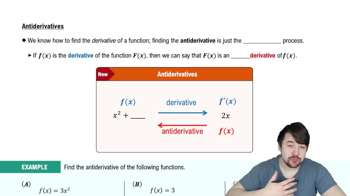
Antiderivative

An antiderivative of a function is another function whose derivative is the original function. In calculus, finding a function from its derivative involves determining the antiderivative, which can be done using integration. The process often includes adding a constant of integration, as the derivative of a constant is zero, meaning multiple functions can share the same derivative.
Video consigliato:
Percorso guidato
05:50
Antiderivatives

Integration Techniques

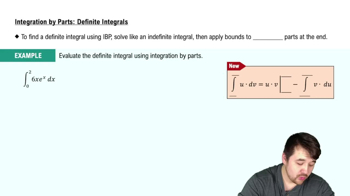
To find the antiderivative of a function, various integration techniques may be employed, such as substitution, integration by parts, or recognizing standard integral forms. For the given derivative, y' = sin(2t) + cos(t/2), one would apply these techniques to integrate each term separately, ensuring to handle any necessary adjustments for constants or variable changes.
Video consigliato:
Percorso guidato
06:18
Integration by Parts for Definite Integrals

Trigonometric Integrals

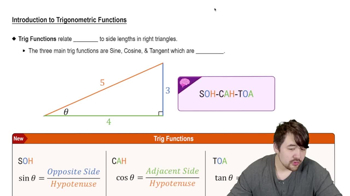
Trigonometric integrals involve integrating functions that include sine and cosine. In the context of the given derivative, integrating sin(2t) and cos(t/2) requires knowledge of their respective antiderivatives. For instance, the integral of sin(kt) is -1/k cos(kt), and the integral of cos(kt) is 1/k sin(kt), where k is a constant that affects the frequency of the sine and cosine functions.
Video consigliato:
Percorso guidato
6:04
Introduction to Trigonometric Functions