Ch. 4 - Applications of Derivatives
Hass - Thomas' Calculus 15th Edition
Hass15th EditionThomas' CalculusISBN: 9780137616077Non è quello che usi tu?Cambia libro di testo
Capitolo 4, Problema 4.6.27c

[Technology Exercises] When solving Exercises 14–30, you may need to use appropriate technology (such as a calculator or a computer).
27. Converging to different zeros Use Newton's method to find the zeros of f(x)=4x^4-4x^2 using the given starting values.
c. x_0 = 0.8 and x_0 = 2, lying in (√2/2, ∞)

Guida verificata passo dopo passo
1
Step 1: Recall Newton's method formula: x_{n+1} = x_n - f(x_n) / f'(x_n). This iterative method is used to approximate the zeros of a function by starting with an initial guess x_0.
Step 2: Compute the derivative of the given function f(x) = 4x^4 - 4x^2. Using the power rule, f'(x) = 16x^3 - 8x.
Step 3: Substitute the given initial values x_0 = 0.8 and x_0 = 2 into the Newton's method formula. For each starting value, calculate f(x_0) and f'(x_0), then compute the next iteration x_1 using the formula x_{n+1} = x_n - f(x_n) / f'(x_n).
Step 4: Repeat the iterative process for each starting value (x_0 = 0.8 and x_0 = 2) until the difference between successive approximations (|x_{n+1} - x_n|) is smaller than a chosen tolerance (e.g., 10^-6). This ensures convergence to a zero of the function.
Step 5: Analyze the results. For x_0 = 0.8, the method should converge to a zero in the interval (√2/2, ∞). Similarly, for x_0 = 2, the method should converge to another zero in the same interval. Use technology (e.g., a calculator or computer) to perform the iterations efficiently.

Risposta video verificata per un problema simile:

Questa soluzione video è stata consigliata dai nostri tutor come utile per risolvere questo problema.
Durata del video:
6m

Concetti chiave

Ecco i concetti essenziali che devi comprendere per rispondere correttamente alla domanda.

Newton's Method

Newton's Method is an iterative numerical technique used to find approximate solutions to equations, particularly for finding roots (or zeros) of functions. The method starts with an initial guess and refines it using the formula x_{n+1} = x_n - f(x_n)/f'(x_n), where f' is the derivative of f. This process continues until the approximation converges to a desired level of accuracy.
Video consigliato:
07:33
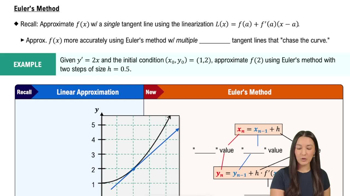
Euler's Method

Zeros of a Function

The zeros of a function, also known as roots, are the values of x for which the function f(x) equals zero. Finding these points is crucial in various applications, including solving equations and analyzing the behavior of functions. In the context of calculus, identifying zeros helps in understanding the function's graph and its intersections with the x-axis.
Video consigliato:
6:37
Zero and Negative Rules

Convergence

Convergence in numerical methods refers to the process by which a sequence of approximations approaches a specific value, often the true solution of an equation. In the context of Newton's Method, convergence is influenced by the choice of the initial guess and the nature of the function. A good initial guess can lead to rapid convergence, while a poor choice may result in divergence or slow convergence.
Video consigliato:
Percorso guidato
04:06
Improper Integrals: Infinite Intervals Example 2