

Ch. 4 - Applications of Derivatives
Hass - Thomas' Calculus 15th Edition
Hass15th EditionThomas' CalculusISBN: 9780137616077Non è quello che usi tu?Cambia libro di testo
Capitolo 4, Problema 4.7.13c

Finding Antiderivatives
In Exercises 1–16, find an antiderivative for each function. Do as many as you can mentally. Check your answers by differentiation.
-sec²(3x/2)

Guida verificata passo dopo passo
1
Recognize that the function given is \(-\sec^{2}\left(\frac{3x}{2}\right)\), which resembles the derivative of the tangent function, since \(\frac{d}{dx}[\tan(u)] = \sec^{2}(u) \cdot \frac{du}{dx}\).
Identify the inner function \(u = \frac{3x}{2}\) and compute its derivative: \(\frac{du}{dx} = \frac{3}{2}\).
Set up the antiderivative integral: \(\int -\sec^{2}\left(\frac{3x}{2}\right) dx\).
Use substitution: let \(u = \frac{3x}{2}\), so \(dx = \frac{2}{3} du\). Rewrite the integral in terms of \(u\): \(\int -\sec^{2}(u) \cdot \frac{2}{3} du = -\frac{2}{3} \int \sec^{2}(u) du\).
Recall that \(\int \sec^{2}(u) du = \tan(u) + C\), so the antiderivative is \(-\frac{2}{3} \tan\left(\frac{3x}{2}\right) + C\).

Risposta video verificata per un problema simile:

Questa soluzione video è stata consigliata dai nostri tutor come utile per risolvere questo problema.
Durata del video:
3m

Concetti chiave

Ecco i concetti essenziali che devi comprendere per rispondere correttamente alla domanda.

Antiderivative (Indefinite Integral)

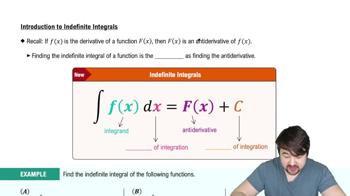
An antiderivative of a function is another function whose derivative equals the original function. It is also called the indefinite integral and includes a constant of integration since differentiation loses constant terms.
Video consigliato:
Percorso guidato
05:04
Introduction to Indefinite Integrals

Derivative of Trigonometric Functions

Knowing the derivatives of basic trig functions like tan(x) and sec(x) is essential. For example, the derivative of tan(x) is sec²(x), which helps in recognizing antiderivatives involving sec² terms.
Video consigliato:
06:35
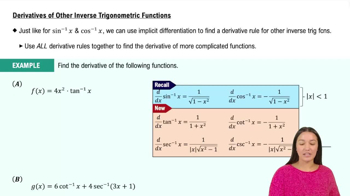
Derivatives of Other Inverse Trigonometric Functions

Chain Rule and Substitution

When functions involve compositions like sec²(3x/2), the chain rule applies. To find antiderivatives, substitution reverses the chain rule by adjusting for the inner function's derivative.
Video consigliato:
05:02
Intro to the Chain Rule
Pratica correlata
Domanda del libro di testo

Identifying Extrema


In Exercises 63 and 64, the graph of f' is given. Assume that f has domain (-2, 2).


" style="max-width: 100%; white-space-collapse: preserve;" width="190">


b. Either use the graph to determine which intervals f is positive on and which intervals f is negative on, or explain why this information cannot be determined from the graph.

231
views
Domanda del libro di testo

Theory and Examples


Sketch the graph of a differentiable function y = f(x) that has a local maximum at (1, 1) and a local minimum at (3, 3).

217
views
Domanda del libro di testo

Analyzing Functions from Derivatives


Answer the following questions about the functions whose derivatives are given in Exercises 1–14:


b. On what open intervals is f increasing or decreasing?


f′(x) = (x − 1)(x + 2)(x − 3)

209
views
Domanda del libro di testo

Finding displacement from an antiderivative of velocity

a. Suppose that the velocity of a body moving along the s-axis is

ds/dt = v = 9.8t − 3.

iii. Now find the body’s displacement from t = 1 to t = 3 given that s = s₀ when t = 0.

29
views
Domanda del libro di testo

[Technology Exercises] When solving Exercises 14–30, you may need to use appropriate technology (such as a calculator or a computer).

27. Converging to different zeros Use Newton's method to find the zeros of f(x)=4x^4-4x^2 using the given starting values.

c. x_0 = 0.8 and x_0 = 2, lying in (√2/2, ∞)

104
views
Domanda del libro di testo

Analyzing Functions from Derivatives


Answer the following questions about the functions whose derivatives are given in Exercises 1–14:

c. At what points, if any, does f assume local maximum or minimum values?


f′(x) = (x − 1)(x + 2)(x − 3)

256
views