Ch. 4 - Applications of Derivatives
Hass - Thomas' Calculus 15th Edition
Hass15th EditionThomas' CalculusISBN: 9780137616077Non è quello che usi tu?Cambia libro di testo
Capitolo 4, Problema 4.5.67

Theory and Examples
67. An inequality for positive integers Show that if a, b, c, and d are positive integers, then
[(a^2+1)(b^2+1)(c^2+1)(d^2+1)]/abcd ≥ 16

Guida verificata passo dopo passo
1
Recognize that the problem involves proving an inequality for positive integers a, b, c, and d. The expression to analyze is \( \frac{(a^2+1)(b^2+1)(c^2+1)(d^2+1)}{abcd} \geq 16 \).
Apply the AM-GM inequality, which states that for any non-negative numbers, the arithmetic mean is greater than or equal to the geometric mean. For two numbers x and y, this is \( \frac{x + y}{2} \geq \sqrt{xy} \).
Consider each term \( a^2 + 1 \), \( b^2 + 1 \), \( c^2 + 1 \), and \( d^2 + 1 \) separately. Apply the AM-GM inequality to each: \( a^2 + 1 \geq 2a \), \( b^2 + 1 \geq 2b \), \( c^2 + 1 \geq 2c \), and \( d^2 + 1 \geq 2d \).
Multiply the inequalities obtained from the AM-GM application: \( (a^2 + 1)(b^2 + 1)(c^2 + 1)(d^2 + 1) \geq (2a)(2b)(2c)(2d) = 16abcd \).
Divide both sides of the inequality by \( abcd \) to obtain \( \frac{(a^2+1)(b^2+1)(c^2+1)(d^2+1)}{abcd} \geq 16 \), thus proving the original inequality.

Risposta video verificata per un problema simile:

Questa soluzione video è stata consigliata dai nostri tutor come utile per risolvere questo problema.
Durata del video:
5m

Concetti chiave

Ecco i concetti essenziali che devi comprendere per rispondere correttamente alla domanda.

Inequality

An inequality is a mathematical statement that compares two values, expressions, or quantities, indicating that one is larger or smaller than the other. In this problem, the inequality involves positive integers and requires proving that a certain expression is greater than or equal to 16. Understanding inequalities is crucial for manipulating and comparing expressions to establish the required relationship.
Video consigliato:
Percorso guidato
5:10
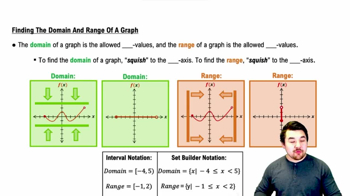
Finding the Domain and Range of a Graph

AM-GM Inequality

The Arithmetic Mean-Geometric Mean (AM-GM) Inequality is a fundamental inequality in mathematics that states for any non-negative real numbers, the arithmetic mean is greater than or equal to the geometric mean. This concept is often used to prove inequalities involving products and sums, and it can be applied here to show that the expression involving a, b, c, and d meets the required condition.
Video consigliato:
Percorso guidato
5:10
Finding the Domain and Range of a Graph

Positive Integers

Positive integers are the set of all whole numbers greater than zero. In this problem, a, b, c, and d are specified as positive integers, which means they are natural numbers. This restriction is important because it influences the properties of the expressions involved, such as ensuring that the product abcd is non-zero, allowing for division and comparison in the inequality.
Video consigliato:
02:33
Determining Concavity Given a Function Example 3