Ch. 4 - Applications of Derivatives
Hass - Thomas' Calculus 15th Edition
Hass15th EditionThomas' CalculusISBN: 9780137616077Non è quello che usi tu?Cambia libro di testo
Capitolo 4, Problema 4.4.93

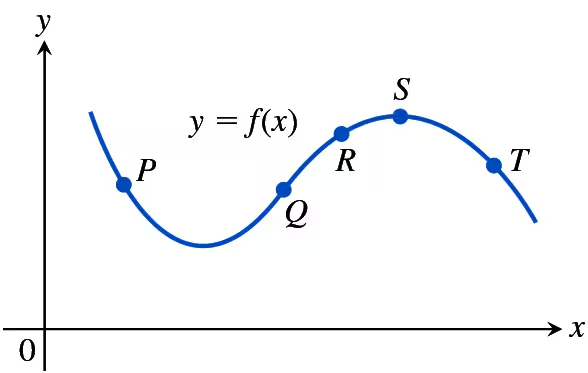
93. The accompanying figure shows a portion of the graph of a twice-differentiable function y=f(x). At each of the five labeled points, classify y' and \(\y\)'' as positive, negative, or zero.
<IMAGE>

Guida verificata passo dopo passo
1
Step 1: Understand the problem. The graph represents a twice-differentiable function y = f(x). At each labeled point (P, Q, R, S, T), we need to classify the first derivative (y') and the second derivative (y'') as positive, negative, or zero based on the behavior of the graph.
Step 2: Analyze point P. At P, the graph is decreasing (sloping downward), so y' < 0. The graph is concave down (curving downward), so y'' < 0.
Step 3: Analyze point Q. At Q, the graph is at a local minimum, meaning the slope is zero (y' = 0). The graph transitions from concave down to concave up, so y'' > 0.
Step 4: Analyze point R. At R, the graph is increasing (sloping upward), so y' > 0. The graph is concave up (curving upward), so y'' > 0.
Step 5: Analyze point S. At S, the graph is at a local maximum, meaning the slope is zero (y' = 0). The graph transitions from concave up to concave down, so y'' < 0.

Risposta video verificata per un problema simile:

Questa soluzione video è stata consigliata dai nostri tutor come utile per risolvere questo problema.
Durata del video:
2m

Concetti chiave

Ecco i concetti essenziali che devi comprendere per rispondere correttamente alla domanda.

First Derivative (y')

The first derivative of a function, y', represents the slope of the tangent line to the graph at any given point. It indicates the rate of change of the function. If y' is positive, the function is increasing; if y' is negative, the function is decreasing; and if y' is zero, the function has a horizontal tangent, indicating a potential local maximum or minimum.
Video consigliato:
07:09
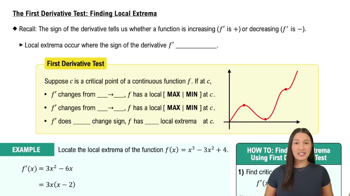
The First Derivative Test: Finding Local Extrema

Second Derivative (y'')

The second derivative, y'', provides information about the concavity of the function. If y'' is positive, the graph is concave up, resembling a 'U' shape, indicating that the slope of the tangent line is increasing. If y'' is negative, the graph is concave down, resembling an 'n' shape, indicating that the slope of the tangent line is decreasing. A zero value for y'' may indicate an inflection point where the concavity changes.
Video consigliato:
06:02
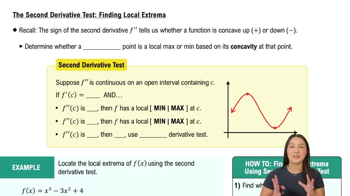
The Second Derivative Test: Finding Local Extrema

Critical Points and Inflection Points

Critical points occur where the first derivative y' is zero or undefined, often corresponding to local maxima or minima. Inflection points occur where the second derivative y'' is zero or changes sign, indicating a change in concavity. Analyzing these points helps in understanding the behavior of the function and its graph, such as identifying peaks, troughs, and points of curvature change.
Video consigliato:
04:50
Critical Points