

Ch. 4 - Applications of Derivatives
Hass - Thomas' Calculus 15th Edition
Hass15th EditionThomas' CalculusISBN: 9780137616077Non è quello che usi tu?Cambia libro di testo
Capitolo 4, Problema 3.9.14c

Use the linear approximation (1 + x)ᵏ ≈ 1 + kx to find an approximation for the function f(x) for values of x near zero.


c. f(x) = 1/√(1 + x)

Guida verificata passo dopo passo
1
Identify the function f(x) = 1/√(1 + x) and recognize that it can be rewritten as (1 + x)^(-1/2).
Use the linear approximation formula (1 + x)ᵏ ≈ 1 + kx, where k is the exponent of the expression. Here, k = -1/2.
Substitute k = -1/2 into the linear approximation formula to get (1 + x)^(-1/2) ≈ 1 - (1/2)x.
This approximation is valid for values of x near zero, providing a simpler expression to estimate f(x) without complex calculations.
Thus, the linear approximation for f(x) = 1/√(1 + x) near x = 0 is approximately 1 - (1/2)x.

Risposta video verificata per un problema simile:

Questa soluzione video è stata consigliata dai nostri tutor come utile per risolvere questo problema.
Durata del video:
2m

Concetti chiave

Ecco i concetti essenziali che devi comprendere per rispondere correttamente alla domanda.

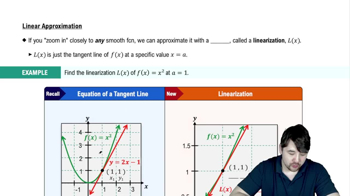
Linear Approximation

Linear approximation is a method used to estimate the value of a function near a given point using the tangent line at that point. For a function f(x), the linear approximation at x = a is given by L(x) = f(a) + f'(a)(x - a). This technique is particularly useful for simplifying complex functions near a specific point, often x = 0.
Video consigliato:

Derivative

The derivative of a function measures how the function's output value changes as its input changes. It is a fundamental concept in calculus, representing the slope of the tangent line to the function at any given point. For the function f(x) = 1/√(1 + x), finding the derivative is crucial for applying linear approximation, as it provides the rate of change needed for the approximation.
Video consigliato:

Binomial Approximation

The binomial approximation (1 + x)ᵏ ≈ 1 + kx is a simplification used when x is near zero. It is derived from the binomial series expansion and is particularly useful for approximating expressions involving powers of binomials. In the context of the given problem, this approximation helps simplify the function f(x) = 1/√(1 + x) by treating it as a binomial expression with k = -1/2.
Video consigliato:
Percorso guidato
04:57
Determining Error and Relative Error