Ch. 7 - Transcendental Functions
Hass - Thomas' Calculus 15th Edition
Hass15th EditionThomas' CalculusISBN: 9780137616077Non è quello che usi tu?Cambia libro di testo
Capitolo 7, Problema 7.2.1f

1. Express the following logarithms in terms of ln 2 and ln 3.
f. ln √(13.5)

Guida verificata passo dopo passo
1
Start by expressing the argument inside the logarithm in terms of numbers whose logarithms you can relate to \( \ln 2 \) and \( \ln 3 \). Note that \( 13.5 = \frac{27}{2} \), since \( 27 = 3^3 \) and \( 2 \) is already a base we want.
Rewrite the expression \( \ln \sqrt{13.5} \) as \( \ln \left( 13.5^{\frac{1}{2}} \right) \) to use the power rule of logarithms.
Apply the power rule of logarithms: \( \ln \left( a^b \right) = b \ln a \). So, \( \ln \sqrt{13.5} = \frac{1}{2} \ln 13.5 \).
Substitute \( 13.5 = \frac{27}{2} \) into the logarithm: \( \frac{1}{2} \ln \left( \frac{27}{2} \right) \).
Use the logarithm quotient rule: \( \ln \left( \frac{a}{b} \right) = \ln a - \ln b \). So, \( \frac{1}{2} ( \ln 27 - \ln 2 ) \). Then express \( \ln 27 \) as \( \ln 3^3 = 3 \ln 3 \).

Risposta video verificata per un problema simile:

Questa soluzione video è stata consigliata dai nostri tutor come utile per risolvere questo problema.
Durata del video:
3m

Concetti chiave

Ecco i concetti essenziali che devi comprendere per rispondere correttamente alla domanda.

Properties of Logarithms

Logarithmic properties such as the product, quotient, and power rules allow us to rewrite complex logarithmic expressions in simpler forms. For example, ln(a * b) = ln a + ln b and ln(a^r) = r ln a. These rules are essential for expressing logarithms in terms of known values.
Video consigliato:
05:36
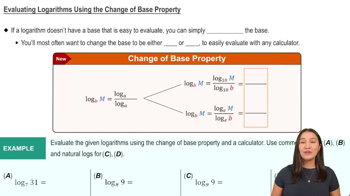
Change of Base Property

Prime Factorization and Simplification

Breaking down numbers into their prime factors helps express logarithms in terms of simpler components. For instance, 13.5 can be factored into 2, 3, and other factors, enabling the use of known logarithms like ln 2 and ln 3 to rewrite the expression.
Video consigliato:
Percorso guidato
11:26
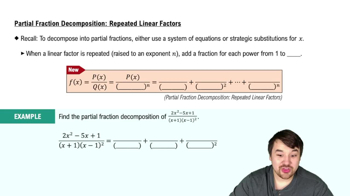
Partial Fraction Decomposition: Repeated Linear Factors

Natural Logarithm (ln) and Its Base

The natural logarithm, denoted ln, is the logarithm with base e. Understanding that ln refers to log base e is crucial, as it allows the use of logarithmic identities and known values (like ln 2 and ln 3) to rewrite expressions involving ln.
Video consigliato:
05:18
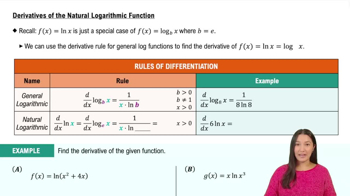
Derivative of the Natural Logarithmic Function