Ch. 7 - Transcendental Functions
Hass - Thomas' Calculus 15th Edition
Hass15th EditionThomas' CalculusISBN: 9780137616077Non è quello che usi tu?Cambia libro di testo
Capitolo 7, Problema 7.8.1.f

1. Which of the following functions grow faster than e^x as x→∞? Which grow at the same rate as e^x? Which grow slower?
f. (e^x)/2

Guida verificata passo dopo passo
1
Recall that the function \(e^x\) is an exponential function with base \(e\), and its growth rate as \(x \to \infty\) is very fast compared to polynomial or logarithmic functions.
Analyze the given function \(f(x) = \frac{e^x}{2}\). This can be rewritten as \(f(x) = \frac{1}{2} e^x\).
Since \(f(x)\) is just \(e^x\) multiplied by a constant factor \(\frac{1}{2}\), the growth rate of \(f(x)\) as \(x \to \infty\) is the same as that of \(e^x\).
In general, multiplying an exponential function by a positive constant does not change its growth rate classification; it only scales the function vertically.
Therefore, \(f(x) = \frac{e^x}{2}\) grows at the same rate as \(e^x\) as \(x \to \infty\).

Risposta video verificata per un problema simile:

Questa soluzione video è stata consigliata dai nostri tutor come utile per risolvere questo problema.
Durata del video:
2m

Concetti chiave

Ecco i concetti essenziali che devi comprendere per rispondere correttamente alla domanda.

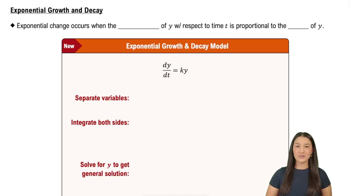
Exponential Growth

Exponential growth describes functions where the variable appears in the exponent, such as e^x. These functions increase rapidly as x approaches infinity, outpacing polynomial and logarithmic functions. Understanding the nature of e^x is essential for comparing growth rates.
Video consigliato:
09:29
Exponential Growth & Decay

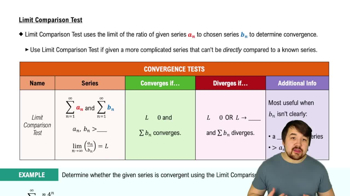
Growth Rate Comparison Using Limits

To compare growth rates of functions as x→∞, we use limits of their ratios. If the limit of f(x)/g(x) is zero, f grows slower; if it is a finite nonzero constant, they grow at the same rate; if infinite, f grows faster. This method helps classify functions by their relative growth.
Video consigliato:
Percorso guidato
07:45
Limit Comparison Test

Constant Multipliers and Their Effect on Growth

Multiplying a function by a constant, like (e^x)/2, does not change its growth rate class. Constants scale the function's value but do not affect how fast it grows compared to other functions as x→∞. Recognizing this helps in identifying equivalent growth rates.
Video consigliato:
09:29
Exponential Growth & Decay