Ch. 7 - Transcendental Functions
Hass - Thomas' Calculus 15th Edition
Hass15th EditionThomas' CalculusISBN: 9780137616077Non è quello che usi tu?Cambia libro di testo
Capitolo 7, Problema 7.P.118

118. A particle is traveling upward and to the right along the curve y=ln(x). Its x-coordinate is increasing at the rate (dx/dt)=√x m/sec. At what rate is the y-coordinate changing at the point (e², 2)?

Guida verificata passo dopo passo
1
Identify the given information: The particle moves along the curve \(y = \ln(x)\), and the rate of change of the x-coordinate with respect to time is given by \(\frac{dx}{dt} = \sqrt{x}\) meters per second.
Recall that the rate of change of the y-coordinate with respect to time, \(\frac{dy}{dt}\), can be found using the chain rule: \(\frac{dy}{dt} = \frac{dy}{dx} \cdot \frac{dx}{dt}\).
Calculate \(\frac{dy}{dx}\) by differentiating \(y = \ln(x)\) with respect to \(x\): \(\frac{dy}{dx} = \frac{1}{x}\).
Evaluate \(\frac{dy}{dx}\) and \(\frac{dx}{dt}\) at the point \((e^{2}, 2)\): Substitute \(x = e^{2}\) into both expressions to find their values at that point.
Multiply the values found in the previous step to get \(\frac{dy}{dt}\) at the point \((e^{2}, 2)\): \(\frac{dy}{dt} = \frac{1}{e^{2}} \times \sqrt{e^{2}}\).

Risposta video verificata per un problema simile:

Questa soluzione video è stata consigliata dai nostri tutor come utile per risolvere questo problema.
Durata del video:
2m

Concetti chiave

Ecco i concetti essenziali che devi comprendere per rispondere correttamente alla domanda.

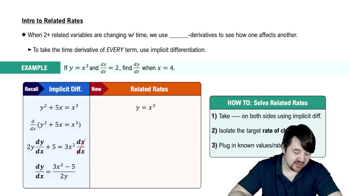
Related Rates

Related rates problems involve finding the rate at which one quantity changes by relating it to the rate of change of another quantity through their functional relationship. Here, the rates of change of x and y with respect to time are connected via the curve equation.
Video consigliato:
Percorso guidato
04:16
Intro To Related Rates

Chain Rule in Differentiation

The chain rule allows differentiation of composite functions. Since y = ln(x) depends on x, which in turn depends on time t, dy/dt is found by multiplying dy/dx by dx/dt, linking the rates of change through the chain rule.
Video consigliato:
05:02
Intro to the Chain Rule

Properties of the Natural Logarithm Function

The natural logarithm function y = ln(x) has a derivative dy/dx = 1/x. This derivative is essential to find how y changes with respect to x, which is then used to determine the rate of change of y with respect to time.
Video consigliato:
Percorso guidato
06:21
Properties of Functions