Ch. 7 - Transcendental Functions
Hass - Thomas' Calculus 15th Edition
Hass15th EditionThomas' CalculusISBN: 9780137616077Non è quello che usi tu?Cambia libro di testo
Capitolo 7, Problema 7.3.155d

155. Which is bigger, πᵉ or e^π?
Calculators have taken some of the mystery out of this once-challenging question.
(Go ahead and check; you will see that it is a very close call.)
You can answer the question without a calculator, though.
d. Conclude that
xᵉ < eˣfor all positivex ≠ e.

Guida verificata passo dopo passo
1
Rewrite the expressions \( \pi^{e} \) and \( e^{\pi} \) in a form that allows comparison using logarithms. Consider taking the natural logarithm of both expressions to compare their sizes without directly calculating their values.
Express the comparison as \( \pi^{e} < e^{\pi} \) if and only if \( e \ln(\pi) < \pi \ln(e) \). Since \( \ln(e) = 1 \), this simplifies to comparing \( e \ln(\pi) \) and \( \pi \).
Define a function \( f(x) = \frac{\ln(x)}{x} \) for \( x > 0 \) to analyze the inequality \( x^{e} < e^{x} \) for \( x \neq e \). The inequality \( x^{e} < e^{x} \) is equivalent to \( e \ln(x) < x \), or \( \frac{\ln(x)}{x} < \frac{1}{e} \).
Find the critical points of \( f(x) = \frac{\ln(x)}{x} \) by differentiating: \( f'(x) = \frac{1 - \ln(x)}{x^{2}} \). Set \( f'(x) = 0 \) to find that the maximum occurs at \( x = e \).
Conclude that since \( f(x) \) attains its maximum at \( x = e \), for all positive \( x \neq e \), \( f(x) < f(e) = \frac{1}{e} \). Therefore, \( x^{e} < e^{x} \) for all positive \( x \neq e \), which includes the comparison between \( \pi^{e} \) and \( e^{\pi} \).

Risposta video verificata per un problema simile:

Questa soluzione video è stata consigliata dai nostri tutor come utile per risolvere questo problema.
Durata del video:
7m

Concetti chiave

Ecco i concetti essenziali che devi comprendere per rispondere correttamente alla domanda.

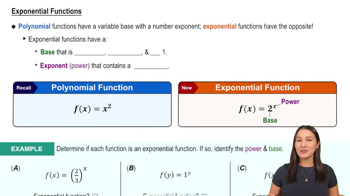
Exponential and Power Functions

Understanding the difference between expressions like πᵉ and e^π requires familiarity with power functions (x raised to a constant) and exponential functions (constant raised to variable). Recognizing how these functions behave for positive real numbers is essential to compare their values without direct computation.
Video consigliato:
6:13
Exponential Functions

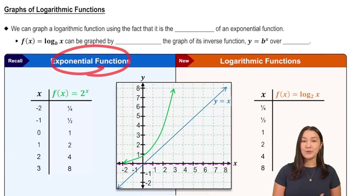
Function Comparison Using Logarithms

Comparing expressions like πᵉ and e^π can be simplified by taking natural logarithms, converting powers into products. This technique transforms the inequality into a comparison of products involving logarithms, making it easier to analyze without a calculator.
Video consigliato:
5:26
Graphs of Logarithmic Functions

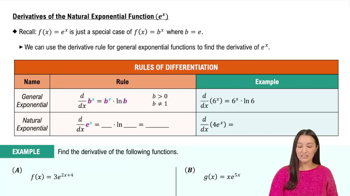
Monotonicity and Critical Points of the Function f(x) = x^{1/x}

The function f(x) = x^{1/x} reaches its maximum at x = e, which helps prove inequalities like xᵉ < eˣ for x ≠ e. Understanding how to find and interpret critical points and monotonicity of such functions is key to concluding the given inequality.
Video consigliato:
04:56
Derivative of the Natural Exponential Function (e^x)
Pratica correlata
Domanda del libro di testo

1. Express the following logarithms in terms of ln 2 and ln 3.

d. ln ∛9

20
views

Domanda del libro di testo

What can you conclude about the inverses of functions whose graphs are lines perpendicular to the line y=x?

28
views
Domanda del libro di testo

In Exercises 67–72, you will explore some functions and their inverses together with their derivatives and tangent line approximations at specified points. Perform the following steps using your CAS:

d. Find the equation for the tangent line to g at the point (f(x_0), x_0) located symmetrically across the 45° line y=x (which is the graph of the identity function). Use Theorem 1 to find the slope of this tangent line.

68. y= (3x+2)/(2x-11), -2 ≤ x ≤ 2, x_0=1/2

22
views
Domanda del libro di testo

82. Use the definitions of the hyperbolic functions to find each of the following limits.

c. lim(x→∞) sinh x

27
views
Domanda del libro di testo

4. Use the properties of logarithms to write the expressions in Exercises 3 and 4 as a single term.

c. 3ln ∛(t² - 1) - ln(t+1)

34
views
Domanda del libro di testo

In Exercises 67–72, you will explore some functions and their inverses together with their derivatives and tangent line approximations at specified points. Perform the following steps using your CAS:

d. Find the equation for the tangent line to g at the point (f(x_0), x_0) located symmetrically across the 45° line y=x (which is the graph of the identity function). Use Theorem 1 to find the slope of this tangent line.

72. y= 2-x-x³, -2 ≤ x ≤ 2, x_0 = 3/2

17
views